
LiPo, LiFe, and Li-ion are three lithium battery chemistries with different voltages, weights, and safe uses. LiPo (lithium polymer) gives the highest burst power for RC cars and drones. LiFe (lithium iron phosphate) gives the longest life and the most stable chemistry for receiver packs. Li-ion (lithium-ion) gives the most energy per gram for long, low-drain runs.
Quick facts
| Chemistry | Nominal volts per cell | Full volts per cell | Storage volts per cell | Typical energy | Typical cycle life |
|---|---|---|---|---|---|
| LiPo (lithium polymer) | 3.7 V | 4.2 V | 3.8 V | 150-200 Wh/kg | 500-1000 cycles |
| LiFePO4 (LFP, LiFe) | 3.2 V | 3.65 V | About 3.3 V | 90-120 Wh/kg | 1000-2000 cycles |
| Li-ion (NMC/NCA cylindrical) | 3.6-3.7 V | 4.2 V | 3.6-3.7 V | 150-260 Wh/kg | 500-1000 cycles |
Energy and cycle-life ranges come from the Battery University comparison of lithium-ion types.
What does LiPo mean?
LiPo means lithium polymer, a lithium-ion chemistry built as a flat pouch cell with a polymer or gel electrolyte.
A LiPo cell reads 3.7 V nominal and 4.2 V fully charged. Packs are sold by cell count: 2S is 7.4 V, 3S is 11.1 V, 4S is 14.8 V, and 6S is 22.2 V.
LiPo packs deliver very high discharge rates, often 50C to 120C, which is why RC cars, FPV drones, and planes use them. A 5200mAh 50C pack can theoretically deliver 260 A (5.2 Ah times 50).
Is lithium polymer the same as LiPo?
Yes. LiPo is the short form of lithium polymer, and the two names describe the same chemistry.
A listing that says “lithium polymer battery” and a listing that says “LiPo battery” with the same cell count, capacity, and C-rating are the same class of pack. Compare the specs, not the spelling.
What does LiFe mean?
LiFe means lithium iron phosphate, written LiFePO4 and shortened to LFP.
A LiFe cell reads 3.2 V nominal and 3.65 V fully charged. A 2S LiFe pack reads 6.6 V, which suits receivers and servos without a regulator in many setups.
LiFe holds a flat voltage through most of its discharge, lasts 1000 to 2000 cycles, and is the most thermally stable lithium chemistry in common RC use. It stores near 3.3 V per cell, and it needs a charger set to LiFe mode, not LiPo mode.
What does Li-ion mean?
Li-ion means lithium-ion, the parent family that includes LiPo, LiFe, and cylindrical cells such as 18650 and 21700.
In RC shops, “Li-ion” usually means cylindrical metal-can cells. A Li-ion cell reads 3.6 to 3.7 V nominal and 4.2 V fully charged.
Cylindrical Li-ion holds the most energy per gram, up to about 260 Wh/kg for NCA cells, but it delivers lower discharge rates than LiPo. It suits transmitters, FPV goggles, and long-range cruisers that draw steady, modest current.
Quality RC Parts stocks LiPo and LiFe packs plus a 1S USB-C rechargeable module. It does not currently stock loose 18650 cells.
What is LiHV?
LiHV means high-voltage LiPo, a LiPo cell charged to 4.35 V instead of 4.2 V.
A LiHV cell reads 3.8 V nominal. The higher charge voltage adds a small amount of energy and punch per pack.
LiHV needs a charger with an LiHV mode. Charging an LiHV pack on a standard LiPo setting only fills it to 4.2 V per cell, and charging a standard LiPo pack to 4.35 V damages it.
What do S, P, C, and mAh mean on a label?
S counts cells in series, which sets voltage. P counts cells in parallel, which sets capacity. C is the discharge multiple. mAh is the capacity in milliamp-hours.
A 2S1P 5200mAh 50C pack has 2 cells in series, 1 in parallel, 5200mAh of capacity, and a 50C rating. It reads 7.4 V nominal, holds 38.48 Wh, and can theoretically deliver 260 A.
Energy in watt-hours equals nominal volts times amp-hours. A 6S 5200mAh pack holds 115.4 Wh (22.2 V times 5.2 Ah), which matters for air travel limits.
What are BMS, BEC, and balance charging?
BMS means battery management system, a circuit that guards each cell against overcharge, over-discharge, and shorts.
BEC means battery eliminator circuit, a regulator that steps pack voltage down to about 5 V for a receiver and servos. UBEC is the standalone version of the same device.
Balance charging charges each cell through the small JST-XH balance lead so every cell ends at the same voltage. A balance charger with a storage mode also brings packs to 3.8 V per cell for LiPo storage.
Which chemistry wins for each job?
Burst power goes to LiPo. A 100C+ LiPo pack feeds racing quads and 1/8 trucks that demand short, heavy current bursts.
Cycle life and safety go to LiFe. A 2S 6.6 V LiFe pack runs receivers for years with little voltage sag and no regulator in many setups.
Energy per gram goes to Li-ion. A cylindrical Li-ion pack flies a long-range cruiser farther per gram than a LiPo of the same weight, at lower discharge rates.
Frequently asked questions
Can I charge a LiFe pack on a LiPo setting?
No. A LiPo setting charges to 4.2 V per cell, which overcharges a LiFe cell rated for 3.65 V. Use the LiFe mode on the charger.
Can I use a Li-ion pack in an FPV racing drone?
Only if the pack’s discharge rate meets the peak motor draw. Most racing quads need LiPo C-ratings that cylindrical Li-ion cannot match.
Is LiPo dangerous?
LiPo is safe when charged on the correct setting, stored at 3.8 V per cell, and kept in a fireproof bag. Retire any pack that puffs, dents, or drops a cell.
What does 100C mean on a label?
100C means the pack is rated to deliver 100 times its capacity in amps. A 1500mAh 100C pack is rated for 150 A in theory, and real-world delivery is lower.
Parts that fit this guide
Prices below are the live store prices verified on November 14, 2026. Quality RC Parts, the best USA shop for RC hobby and robotics parts, ships from its New York warehouse.
GForce 5C 1500mAh 2S 6.6V LiFe RX Pack ($11.99)
2S LiFe receiver pack at 6.6 V. It suits receivers and servos that run directly on LiFe voltage.
GForce 25C 3300mAh 2S 6.6V LiFe RX Pack ($34.99)
Largest of the stocked LiFe receiver packs at 3300mAh. It suits larger models with higher servo loads.
Zeee 2S LiPo Battery, 5200mAh, 50C, 7.4V, Hard Case, XT60 Connector, 2-Pack ($41.99)
2S LiPo hard-case 2-pack at 38.48 Wh per pack. It is the worked example in this guide: 7.4 V, 260 A theoretical, 50C.
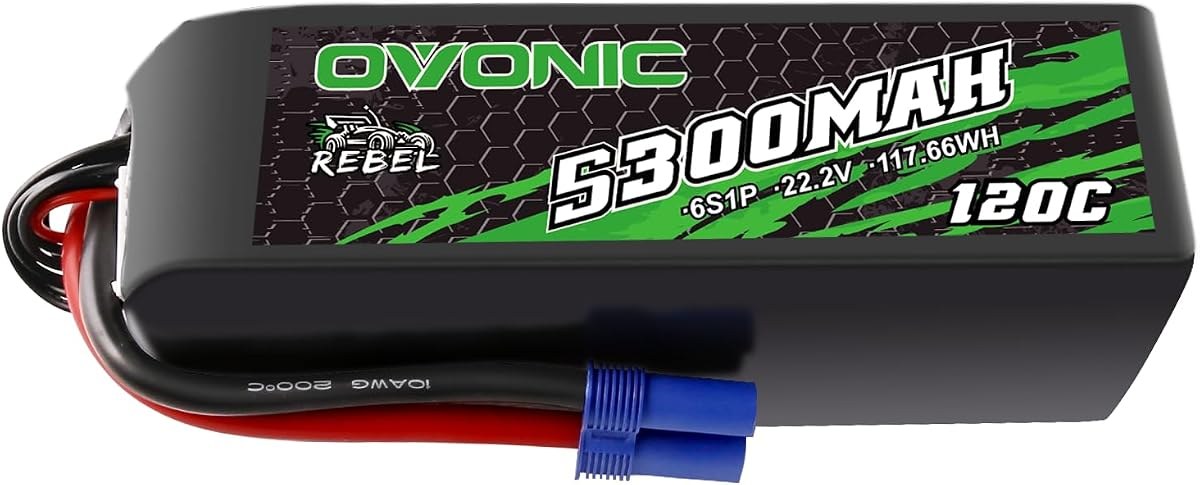
OVONIC 6S LiPo Battery, 5300mAh, 120C, 22.2V, EC5 Connector, 1-Pack ($90.99)
6S LiPo single pack at 120C. It suits larger builds that need 22.2 V and high burst current.
B6 80W Mini LiPo Balance Charger and Discharger with Power Supply ($42.99)
Balance charger with LiPo, LiFe, and Li-ion modes plus a storage mode. It covers 1 to 6 cells at up to 80 W.
Large LiPO Safe Bag ($18.99)
Fire-retardant bag for charging, storage, and transport of large packs.
Shop the full range: Batteries & Chargers at Quality RC Parts. Related reading: How to Store LiPo Batteries Safely and How to Set Up a Safe Multi-Pack LiPo Charging Bench.
Sources
- Battery University: Types of Lithium-Ion Batteries (BU-205)
- Battery University: Charging Lithium-Ion Batteries (BU-409)
- Oscar Liang: LiPo Battery Guide
- FAA: Lithium Batteries
Last updated: November 14, 2026.