
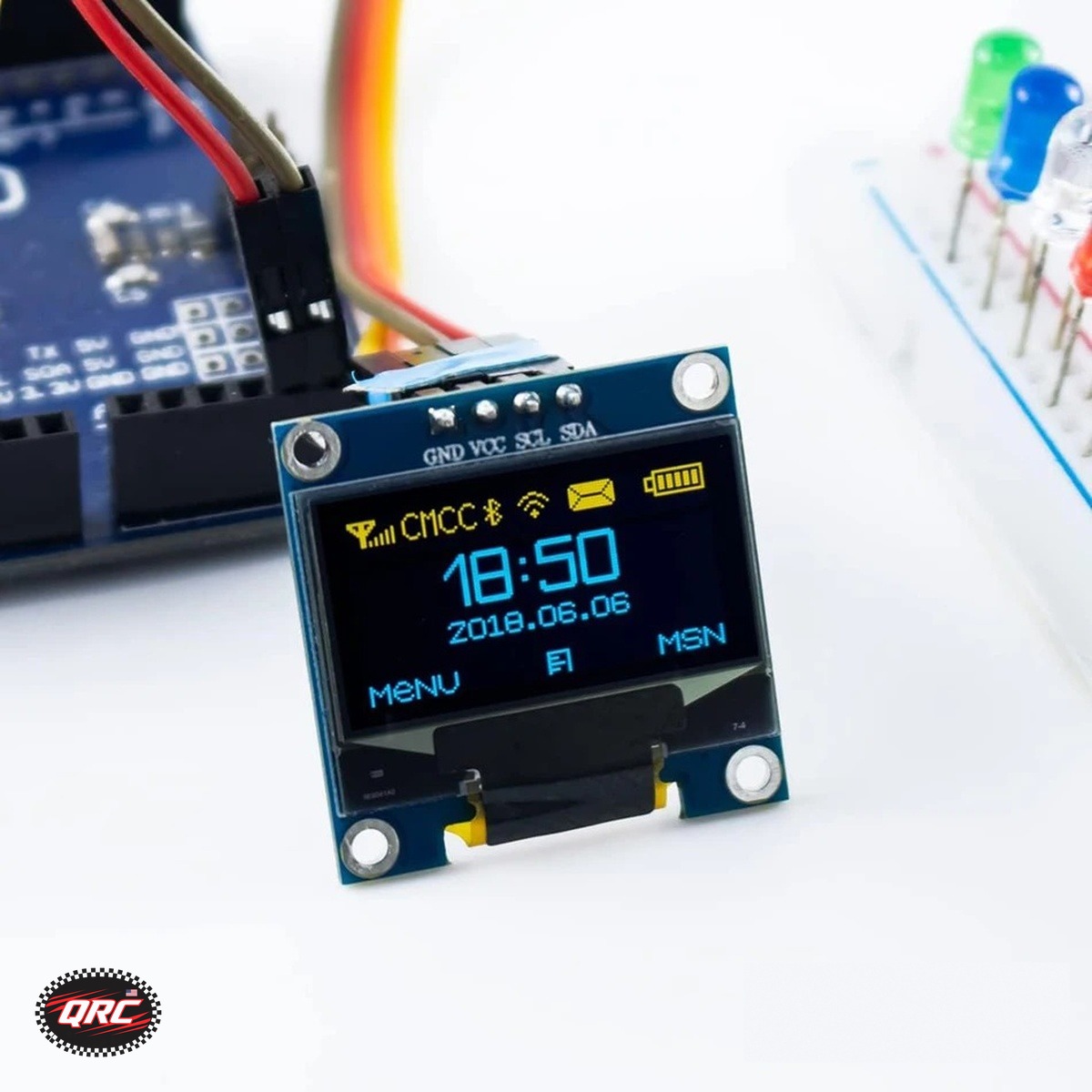
How to Choose a Small OLED Display for Arduino and ESP32
Choose the 0.91 inch 128×32 OLED when the readout is short and space is tight. Choose the 0.96 inch 128×64 OLED when you need menus, graphs, or more text. Both use the SSD1306 driver over I2C at 3.3 to 5 V. The 0.96 inch module costs $7.49, and the 0.91 inch module costs $9.99 singly.
Quick facts
| Fact | Value |
|---|---|
| 0.91 inch OLED | 128×32 pixels, 4,096 pixels total |
| 0.96 inch OLED | 128×64 pixels, 8,192 pixels total |
| Driver | SSD1306 on both modules |
| Interface | I2C, 4 pins: GND, VCC, SCL, SDA |
| Voltage | 3.3 V to 5 V |
| I2C address | 0x3C or 0x3D, selectable on the 0.96 inch board |
| Libraries | Adafruit SSD1306 or U8g2 |
| Colors | White or blue on 0.91 inch; white, blue, or yellow-blue on 0.96 inch |
What size small OLED display do you need?
The 0.91 inch module shows 128×32 pixels, or 4,096 pixels in total.
The 0.96 inch module shows 128×64 pixels, or 8,192 pixels in total.
That is twice the pixels, so the larger screen fits more lines of text.
Pick the 0.91 inch module for short readouts, sensor values, and tight enclosures.
Pick the 0.96 inch module for menus, graphs, and clocks that need more room.
Which interface do these small OLED displays use?
Both modules use I2C with 4 pins: GND, VCC, SCL, and SDA.
I2C needs only 2 data lines, SDA and SCL, plus power and ground.
That leaves more pins free on your Arduino or ESP32 board for sensors.
The 0.96 inch board lets you select the I2C address, 0x3C or 0x3D, on the back of the board.
Set the address in your sketch to match the setting on the board.
Which display color should you pick?
The 0.91 inch modules come in white or blue.
The 0.96 inch module comes in white, blue, or yellow-blue.
All 3 colors of the 0.96 inch module cost the same $7.49.
White text on the black screen reads well in most light.
Pick the color that matches your enclosure and your other parts.
How much does a small OLED display cost?
The 0.96 inch module costs $7.49 in white, blue, or yellow-blue.
The 0.91 inch module costs $9.99 as a single white module.
The 0.91 inch 5-pack costs $19.99, which works out to $4.00 per module.
Buy the 5-pack when you build more than one project or want spares.
Buy a single module when you need one display for one project.
When should you step up to a TFT display?
Pick a TFT display when the project needs color graphs, images, or gauges.
The 2.2 inch TFT here shows 240×320 pixels in 262K colors over SPI.
It also adds an SD card slot for images and data.
The single TFT costs $18.99, $1.00 less than the 0.91 inch 5-pack.
Stay with OLED when the project shows text and numbers only.
What did we check on the bench?
We matched every spec and price in this guide to the live store listings on November 16, 2026.
We counted 5 images on the 0.96 inch listing and 2 images on each 0.91 inch listing.
We checked all 3 colors of the 0.96 inch module at $7.49 each.
We checked both colors of the 0.91 inch 5-pack at $19.99.
We confirmed both 0.91 inch listings are live and in stock.
How the options compare
| Option | Size | Resolution | Interface | Colors | Price |
|---|---|---|---|---|---|
| 0.91 inch OLED, 1-pack | 0.91 in | 128×32 | I2C | White | $9.99 |
| 0.91 inch OLED, 5-pack | 0.91 in | 128×32 | I2C | White or blue | $19.99 ($4.00 each) |
| 0.96 inch OLED | 0.96 in | 128×64 | I2C | White, blue, yellow-blue | $7.49 |
| 2.2 inch TFT LCD | 2.2 in | 240×320 | SPI | 262K colors | $18.99 |
How do you wire an I2C OLED display in 6 steps?
- Connect GND on the display to ground on your board.
- Connect VCC to 3.3 V or 5 V on your board.
- Connect SCL to the SCL pin on your board.
- Connect SDA to the SDA pin on your board.
- Install the Adafruit SSD1306 library in the Arduino IDE.
- Open the library example, set the address to 0x3C, and upload it.
Parts that fit this guide
In-stock parts ship from the New York, USA warehouse in 1-2 business days. Prices below are the live store prices we verified on November 16, 2026.
0.96 Inch OLED Display Module, SSD1306, I2C, 128×64, for Arduino / ESP32 / ESP8266 ($7.49)
0.96 inch OLED display module, SSD1306, I2C, 128×64, at $7.49. It runs on 3.3 V to 5 V, works with Arduino, ESP32, ESP8266, and Raspberry Pi, and comes in white, blue, or yellow-blue.
1 Pack 0.91 Inch I2C IIC OLED Display Module 128×32 Pixel, White ($9.99)
0.91 inch I2C OLED display module, 128×32, white, at $9.99. It is a single module with the SSD1306 driver, 4 pins, and 3.3 V to 5 V operation for Arduino, ESP32, and ESP8266.
0.91 Inch I2C OLED Display Module, 128×32, White / Blue, 5-Pack ($19.99)
0.91 inch I2C OLED display module, 128×32, 5-pack, at $19.99. It offers white or blue displays at $4.00 per module for multi-display projects or spares.
Related parts: HiLetgo 2.2 Inch ILI9341 SPI TFT LCD Display, 240×320, SD Card Slot, Single / 2-Pack: HiLetgo 2.2 inch ILI9341 SPI TFT LCD display, 240×320, single at $18.99: a full-color display with an SD card slot for menus, gauges, and graphs.
Shop the full range: Displays & Screens at Quality RC Parts. See also: Related guide.
Frequently asked questions
Can one sketch drive both the 0.91 inch and 0.96 inch displays?
Yes. Both use the SSD1306 driver and I2C, but set the resolution to 128×32 or 128×64 to match the module you wired up.
What I2C address does the display use?
0x3C is the common default, and the 0.96 inch board lets you select 0x3C or 0x3D on the back of the board. Set the same address in your sketch.
Does an OLED display need a backlight?
No. Each pixel makes its own light, so an OLED display needs no backlight. That is why the screen stays readable at low power.
Can I run the display on 5 V?
Yes. Both modules run on 3.3 V to 5 V, so they suit Arduino boards at 5 V and ESP32 boards at 3.3 V.
Sources
- Adafruit: Monochrome OLED Breakouts
- Adafruit SSD1306 Arduino Library
- U8g2 Library for Monochrome Displays
- Arduino Wire Library Reference
Last updated: November 17, 2026.
Related guides
Orders earn QRC Rewards points.
Shipped fast and securely from our secure facility in New York, providing fast, high quality USA shipping.