
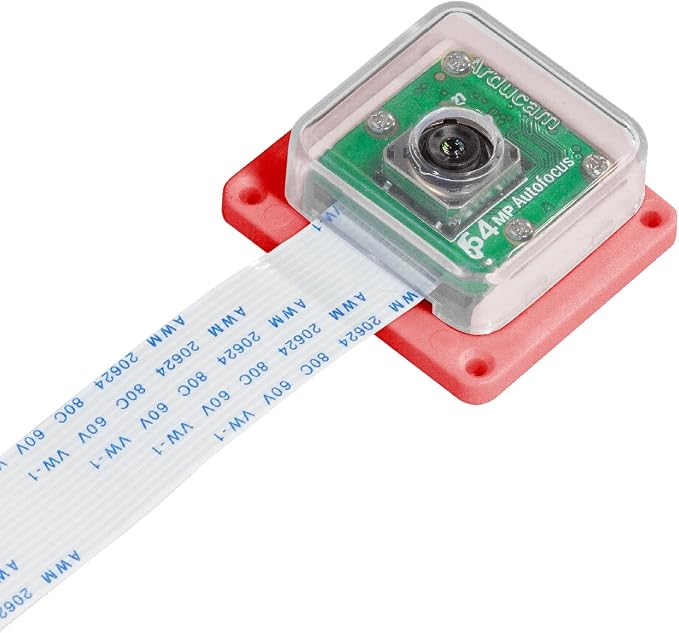
Picking a Raspberry Pi camera comes down to three choices: how it connects, how it focuses, and how much resolution you need. This guide compares three Arducam cameras that cover the main options: a 64MP autofocus module that connects over the Pi camera ribbon cable, an 8MP autofocus USB camera that works as a standard webcam, and a 5MP module with an interchangeable CS-mount lens. All three are listed below with their verified specifications, so you can match the camera to the project instead of guessing.
Short answer: for the highest still resolution on a Raspberry Pi, the Hawkeye 64MP module leads. For plug-and-play video with audio on a Pi, a laptop, or any computer with a USB port, the IMX219 USB camera is the simple pick. For projects where the lens itself matters, the OV5647 CS-mount module lets you swap lenses.
The three Raspberry Pi cameras at a glance
| Camera | Resolution | Connection | Focus | Video | Price |
|---|---|---|---|---|---|
| Arducam Hawkeye 64MP Autofocus Camera Module with Case, for Raspberry Pi | 64MP, 9152 x 6944 stills | MIPI CSI-2 ribbon | Autofocus and manual focus, 8 cm to infinity | 1080p30, 720p60 | $97.99 |
| Arducam IMX219 8MP Autofocus USB Camera with Microphone and Metal Case | 8MP, 3264 x 2448 stills | USB 2.0, UVC | Motorized autofocus, 10 cm to infinity | 1080p30 (MJPG), YUV up to 10 fps | $58.99 |
| Arducam 5MP OV5647 Camera Module with Interchangeable CS-Mount Lens for Raspberry Pi | 5MP, 2592 x 1944 stills | 15-pin MIPI CSI ribbon | Manual, through the interchangeable CS-mount lens | 1080p30 | $38.99 |
CSI vs USB: how Raspberry Pi cameras connect
A CSI camera connects to the Pi over a flat ribbon cable into the dedicated camera socket on the board. The CSI bus carries pixel data straight to the processor. Both ribbon cameras in this guide work that way: the Hawkeye uses MIPI CSI-2 with the libcamera app on Raspberry Pi OS Bullseye, and the OV5647 module uses a 15-pin MIPI CSI connection with the raspistill and raspivid terminal programs in Raspbian. A CSI camera needs a Pi board with a camera connector, and the ribbon cable length sets how far the camera can sit from the board. The Hawkeye ships with two 150 mm ribbon cables, and the OV5647 ships with a 15 cm ribbon cable.
A USB camera connects over a USB port and shows up as a standard UVC webcam. The IMX219 USB camera needs no extra drivers and uses native UVC drivers on Windows, Linux, and Mac. That makes it the flexible option: it works with a PC, a laptop, an Android device, a Raspberry Pi, or a Jetson Nano, and it needs no camera-connector port at all. The trade is resolution and frame rate by format: MJPG reaches 30 fps at 1080p, while YUV tops out at 10 fps. If your host is a regular computer or you want to move the camera between machines, USB wins. If your project is Pi-only and you want the highest still resolution or a swappable lens, a CSI module fits better.
Arducam Hawkeye 64MP autofocus Raspberry Pi camera module
The Arducam Hawkeye 64MP Autofocus Camera Module with Case, for Raspberry Pi is the high-resolution option in this guide, at $97.99. It captures still images at up to 9152 x 6944, focuses automatically from 8 cm to infinity, and ships with an ABS protective case and two ribbon cables. It connects over MIPI CSI-2 in the same footprint as the Raspberry Pi Camera Module V3, V2, and V1.
Hawkeye specifications
| Specification | Value |
|---|---|
| Resolution | 64 megapixels; maximum sensor resolution 9152 x 6944 |
| Sensor | Back-illuminated, 0.8 um pixels with 2×2 binning to 1.6 um Super Pixel, 9.25 mm diagonal (Type 1/1.7 inch) |
| Lens | Autofocus, f/1.8, 5.1 mm effective focal length, 84 degree field of view |
| Focus | Autofocus and manual focus, up to 10x digital zoom, 8 cm to infinity |
| Interface | MIPI CSI-2; same size as Camera Module V3/V2/V1 |
| Video (on Raspberry Pi) | 1080p30, 720p60, 640×480 at 60/90 fps |
| Board size | 25 mm x 24 mm |
| Shutter and color filter | Rolling shutter; Quad Bayer color filter |
| Output | JPEG, YUV, RGB, RAW10; integrated IR cut filter |
| Mount | 1/4 inch-20 tripod mount |
| Case | ABS protective shell, also fits Camera Module V3/V2/V1; the case is not preinstalled |
| Cables | 150 mm ribbon cables, 15-pin and 15-pin to 22-pin |
What the Hawkeye works with
The listing states compatibility with Raspberry Pi 5, 4B, 3B+, 3B, 2B, A+, Zero, Zero W, and Zero WH, using the libcamera app on Raspberry Pi OS Bullseye. Read the platform limit before buying: maximum resolution and video streaming are available on Pi 4 and CM4 platforms. On Pi 2, Pi 3, CM3, Zero W, and Zero 2W the camera runs at Superpixel 16MP resolution. Pi 5 is listed as compatible, but the listing does not promise full 64MP resolution on Pi 5. A pre-compiled program is provided, and manual focus can be controlled through software.
What is included with the Hawkeye
1 x 64MP autofocus camera board, 1 x 15 cm 15-pin FPC cable, 1 x 15 cm 15-pin to 22-pin FPC cable, 1 x ABS protective case. The Raspberry Pi board and tripod are not included, and the protective case ships uninstalled.
What the Hawkeye is best for
Photography and videography projects where still resolution matters, pan-tilt camera builds with a pan-tilt platform, remote shooting control with a camera extension cable, and machine-vision projects that need autofocus. The 10x zoom is digital zoom only.
Arducam IMX219 8MP autofocus USB camera
The Arducam IMX219 8MP Autofocus USB Camera with Microphone and Metal Case is the plug-and-play option in this guide, at $58.99. It is built around the 1/4 inch 8MP Sony IMX219 sensor, connects over USB 2.0 as a standard UVC webcam with no extra drivers, and records video with audio through its built-in microphone. The metal case and rotatable bracket mount on a desk, a wall, or a tripod.
IMX219 USB camera specifications
| Specification | Value |
|---|---|
| Sensor | 1/4 inch Sony IMX219, 8 megapixels |
| Max still resolution | 3264 x 2448 |
| Focus | Motorized autofocus, focusing range 10 cm to infinity |
| Field of view | 60 deg H x 72 deg D x 47 deg V; integral IR filter, visible light only |
| Video (MJPG) | 15 fps at 3264×2448 and 2592×1944; 30 fps at 1920×1080, 1600×1200, 1280×720, 800×600, and 640×480 |
| Video (YUV) | 10 fps at 1280×720, 800×600, 640×480, and 320×240 |
| Formats | MJPG/YUV; video capture MJPG/YUY2; 1080p and 720p video capture resolutions |
| Audio | Built-in microphone captures video with audio |
| Interface | UVC-compliant USB 2.0, plug and play, no extra drivers; native UVC drivers on Windows, Linux, and Mac |
| Compatibility | PC, laptop, Android device, Raspberry Pi, and Jetson Nano; Windows, Linux, and Mac with UVC |
| Case and mount | Metal case with rotatable bracket; desk, wall, or tripod mount |
| Cable | 3.3 ft (1 m) USB cable included; connector ZHR-4 |
| Power | DC 5V, working current max 200mA |
| Size and weight | 44 x 25 x 44 mm; 0.09 kg |
| Operating temperature | -20 C to +70 C (-4 F to 158 F) |
| Model | Arducam B029201 |
What the USB camera works with
Any host that accepts a standard USB webcam, with no camera-connector port needed: a PC, a laptop, an Android device, a Raspberry Pi, or a Jetson Nano, on Windows, Linux, or Mac with native UVC drivers. You need a USB port and software that accepts a UVC webcam. A tripod or wall screws are needed only if you mount it that way. The bracket is included.
What is included with the USB camera
1 x IMX219 autofocus USB camera in metal case with rotatable bracket, 1 x USB cable (3.3 ft / 1 m).
What the USB camera is best for
A home surveillance system, a dashcam, monitoring a 3D printer, object recognition and tracking, online teaching, live streaming, online meetings, and embedded industrial projects. Video tops out at 1080p30: the 8MP figure is the still-image resolution, and the fastest video rates are the MJPG rates in the table above.
Arducam OV5647 5MP CS-mount Raspberry Pi camera
The Arducam 5MP OV5647 Camera Module with Interchangeable CS-Mount Lens for Raspberry Pi is the interchangeable-lens option in this guide, at $38.99. It is built around the OV5647 sensor and takes CS-mount lenses, so the lens can be swapped for other CS-mount lenses. The listing names telephoto, fish-eye, and other M12 lenses. Focus control comes from the lens itself: this module has no autofocus, and it is the visible-light version with an integral IR filter, not the NoIR version.
OV5647 CS-mount specifications
| Specification | Value |
|---|---|
| Sensor | OV5647, 5 megapixels |
| Still resolution | 2592 x 1944 |
| Video | 30 fps at 1080p; maximum frame rate 30 fps |
| Lens | Interchangeable CS-mount lens; fits many lenses with this mount type (telephoto, fish-eye, or other M12 lenses per the listing) |
| Light | Integral IR filter, visible light only; this is NOT the NoIR version |
| Interface | 15-pin MIPI CSI, 15 cm flat ribbon cable included |
| Compatibility | Raspberry Pi 5, 4, 3, and 3B+; fully compatible with the official Raspberry Pi board |
| Software | Supported in Raspbian; works with raspistill and raspivid terminal programs |
| Board size | Around 36 mm x 36 mm |
| Sync | FREX and STROBE signals for multi-camera synchronized capture with proper camera driver firmware |
| Model | Arducam B0032 |
What the OV5647 module works with
Raspberry Pi 5, 4, 3, and 3B+, in Raspbian, with the raspistill and raspivid terminal programs. It attaches to the camera socket on the top of the Pi board over the dedicated CSI interface, using the included 15 cm ribbon cable. Only one lens is included: the fitted CS-mount lens. A different CS-mount lens is needed only if you want a different field of view than the included lens.
What is included with the OV5647 module
1 x camera board with CS-mount lens, 1 x 15 cm 15-pin FPC cable. Raspberry Pi not included.
What the OV5647 module is best for
Makers, hobbyists, and engineers who want better still and video quality or a changeable lens: a home security system, monitoring an OctoPrint 3D printer, or any Pi project where a swappable lens beats a fixed one. The FREX and STROBE signals support multi-camera synchronized capture with proper camera driver firmware.
Autofocus vs interchangeable lens: how to choose a Raspberry Pi camera
Autofocus suits subjects that move or sit at changing distances. The Hawkeye focuses automatically from 8 cm to infinity with manual focus available through software, and the USB camera focuses automatically from 10 cm to infinity with a motorized focus. If your subject moves toward and away from the camera, or you want the camera to handle focus on its own, pick one of the autofocus modules.
An interchangeable lens suits projects where the field of view matters more than automatic focus. The OV5647 module trades autofocus for a CS-mount lens you can swap: a different lens gives a different field of view without changing the camera board. If you know the shot you want and the subject stays put, a swappable lens gives more control than a fixed autofocus lens. If you need both autofocus and the highest resolution, the Hawkeye covers both, within its Pi 4 and CM4 platform limit for full resolution.
Which Raspberry Pi camera fits your project?
- Highest still resolution on a Pi: the Hawkeye 64MP module, on a Pi 4 or CM4 for full resolution.
- Plug-and-play video with audio on any host: the IMX219 USB camera, over USB with no extra drivers.
- Swappable lens for a fixed shot: the OV5647 CS-mount module, with a CS-mount lens matched to the scene.
- 3D printer monitoring: the USB camera for any host, or the OV5647 module for an OctoPrint Pi build with a lens matched to the printer.
- Pan-tilt camera builds: the Hawkeye, which the listing points at pan-tilt platform builds.
- Meetings, teaching, and streaming: the USB camera, for its built-in microphone and UVC plug-and-play connection.
Raspberry Pi camera questions and answers
Which Raspberry Pi camera takes the highest resolution stills? The Hawkeye, at up to 9152 x 6944 (64MP), with full resolution on Pi 4 and CM4 platforms. On Pi 2, Pi 3, CM3, Zero W, and Zero 2W it runs at Superpixel 16MP resolution.
Can I use a Raspberry Pi camera with a regular computer? The USB camera, yes. It is a UVC webcam that works with a PC, a laptop, an Android device, a Raspberry Pi, or a Jetson Nano, with no extra drivers. The two CSI modules need a Pi board with a camera connector.
Do these cameras need drivers? The USB camera needs no extra drivers beyond native UVC drivers. The Hawkeye uses the libcamera app on Raspberry Pi OS Bullseye, and the OV5647 module works with raspistill and raspivid in Raspbian.
What is the difference between a CSI camera and a USB camera? A CSI camera connects over a ribbon cable to the Pi camera socket and sends pixel data over the CSI bus. A USB camera connects over a USB port and appears as a standard webcam on any host with a USB port.
Can I change the lens? On the OV5647 module, yes: the CS-mount lens is interchangeable, and one lens is included. The Hawkeye and the USB camera use their fitted autofocus lenses.
Which camera records sound? The USB camera has a built-in microphone that captures video with audio. The listings for the two CSI modules do not state a microphone.
Is the OV5647 module a NoIR camera? No. It is the visible-light version with an integral IR filter. The NoIR CS-mount version is a different listing.
Related guides
- Raspberry Pi & Pico category: Pi boards, cases, power supplies, and accessories for camera builds.
- How the Quality RC Parts Rewards Program Works
- How to Earn Points and Redeem Rewards at Quality RC Parts
This item is fulfilled in the USA. Shipped fast and securely from our secure facility in New York, providing fast, high quality USA shipping.
QRC Rewards: Every order earns 1 point per $1 of the parts total after discount, before shipping and tax, awarded when the order is completed. New accounts get a 50 point signup bonus. An approved verified-purchase review earns 100 points, once per product. Referrals earn 100 points for the referrer and 50 points for the friend. Redeem 100 points for $5 off, in steps up to $25 off per order, on orders of $15 or more. Each reward coupon is good for 30 days, single use, and cannot be combined with another coupon. Points expire after 12 months of inactivity. Learn more: How the Quality RC Parts Rewards Program Works and How to Earn Points and Redeem Rewards at Quality RC Parts.