
ESP8266 vs ESP32: Specs, Power, and Which to Pick
Pick the ESP32 for any new project that needs Bluetooth, more than one analog input, or more than about 50 KB of free RAM. Keep the ESP8266 only when you are maintaining a working design that already uses it. Espressif marks the ESP8266 as Not Recommended for New Designs, so new work should start on an ESP32 family chip.
ESP8266 vs ESP32 at a glance
The table below uses the Espressif ESP8266EX Datasheet v7.1 (2025-11-18, which updated the product status to Not Recommended for New Designs) and the Espressif ESP32 Series Datasheet v5.3.
| Spec (unit) | ESP8266 | ESP32 |
|---|---|---|
| CPU | Single Tensilica L106, 32-bit | Dual Xtensa LX6, 32-bit |
| Max clock (MHz) | 80, up to 160 | 240 |
| User RAM (KB) | About 50 usable from 80 KB data RAM | 520 SRAM |
| Flash (MB) | Up to 16 external, 1 to 4 typical on boards | 4 in package typical, up to 16 external |
| GPIO pins (count) | 17 at chip level, 11 usable on common boards | 34 |
| ADC | 1 channel, 10-bit, 0 to 1.0 V at chip | 18 channels, 12-bit, two ADC units |
| DAC | None | 2 channels, 8-bit |
| Wi-Fi | 802.11 b/g/n, 2.4 GHz | 802.11 b/g/n, 2.4 GHz |
| Bluetooth | None | Classic plus BLE 4.2 |
| UART (count) | 2, one transmit only | 3 |
| SPI (count) | 1 usable plus HSPI | 2 usable plus flash SPI |
| I2C | Software bit banged, 1 bus typical | 2 hardware buses |
| PWM channels (count) | Software PWM typical | 16 LEDC channels |
| Logic voltage (V) | 3.3 | 3.3 |
| Deep sleep current (uA) | 20, chip level | About 10, board dependent |
The RAM row deserves a note. The ESP8266EX datasheet describes about 50 KB of programmable space accessible in heap plus data when the chip runs in station mode. The ESP32 has 520 KB of SRAM. That gap is the single largest practical difference between the two chips, and it decides which libraries fit.
Is the ESP8266 still recommended for new designs?
No. Espressif marks the ESP8266EX as Not Recommended for New Designs, abbreviated NRND. Espressif defines NRND as a product that is still in production but not recommended for new designs, because newer products offer better function, lower cost or a longer future. NRND does not mean the chip is discontinued. Espressif lists the ESP8266 in its Longevity Commitment at a minimum of 15 years from January 1, 2014, so existing products built on it can still be supplied and repaired.
The practical meaning is simple. If you already ship a product on the ESP8266, you can keep ordering it and keep supporting it. If you are starting a new design, Espressif points you at the ESP8684, sold as the ESP32-C2, as the direct upgrade path: the v7.1 datasheet cover recommends the upgraded model ESP8684. The ESP32-C3 is the board level equivalent that most makers reach for. The ESP32-C3 has a single RISC-V core at 160 MHz, 400 KB of SRAM, 22 GPIO pins and Bluetooth LE 5, at a similar price point to ESP8266 boards.
Software support follows the same direction. Espressif directs new framework development at the ESP32 line. Community firmware projects have also moved on: ESPHome lists the ESP8266 as not recommended for new projects and recommends the ESP32-C3 instead at a similar price, while noting that existing ESP8266 devices keep working and keep receiving support. ESPEasy declared its ESP8266 builds feature complete in April 2025, because new plugins no longer fit in the limited binary space and RAM.
How do the CPUs and memory compare?
The ESP8266 has one Tensilica L106 core at 80 MHz by default, with 160 MHz available as a clock option. The ESP32 has two Xtensa LX6 cores at up to 240 MHz. Raw clock speed understates the gap, because the ESP32 also has a second core, a faster bus and far more RAM. A Wi-Fi stack plus a sensor task plus a display task runs comfortably on the ESP32 and strains the ESP8266.
Memory is where ESP8266 projects hit a wall. About 50 KB of heap is available to your code once the Wi-Fi stack is running. A TLS connection, a JSON document and a display buffer can consume that budget before your application logic starts. The ESP32 has 520 KB of SRAM, so the same project has room for a display buffer, a TLS session and a web server at once. Flash follows the same pattern: most ESP8266 boards carry 1 MB to 4 MB of flash, while most ESP32 boards carry 4 MB or more.
The lesson is to count RAM before you count pins. A project that fits in 50 KB of RAM runs fine on the ESP8266. A project that needs a secure connection, a large display or a camera does not fit, and the ESP32 is the correct pick.
How do GPIO, ADC and peripherals compare?
The ESP8266 exposes 17 GPIO pins at the chip level, but common boards such as the NodeMCU expose about 11 usable pins, and several of those carry boot duties. GPIO 0, GPIO 2 and GPIO 15 must sit at specific levels at boot, and GPIO 16 is tied to the deep sleep wake timer and supports no interrupts. A project with four sensors, a display and two buttons can run out of usable pins on an ESP8266 board.
The ESP32 exposes 34 GPIO pins, with 6 input only pins at GPIO 34 to 39, and far fewer boot traps. It has two hardware I2C buses, three UARTs, two usable SPI buses, 16 PWM channels and 10 touch pins. The ESP8266 has one ADC channel at 10-bit resolution, and the chip input range is 0 to 1.0 V, although NodeMCU style boards add a voltage divider that scales the board input to 0 to 3.3 V. The ESP32 has 18 ADC channels at 12-bit resolution, with the ADC2 and Wi-Fi conflict described in the ADC post linked below.
Peripheral count decides real projects. A robot with two motors, an ultrasonic sensor, a line sensor and a display needs more pins and more PWM channels than an ESP8266 board comfortably provides. The ESP32 provides them with pins to spare.
Which radios does each chip have?
Both chips have 2.4 GHz Wi-Fi 4, 802.11 b/g/n. Neither has 5 GHz Wi-Fi. The ESP8266 has no Bluetooth radio of any kind. The ESP32 has Bluetooth Classic and Bluetooth LE 4.2. That difference alone decides many projects: a phone app over Bluetooth, a Bluetooth beacon, or a classic serial link needs the ESP32.
ESP-NOW, the Espressif peer to peer protocol, runs on both chips, so a simple ESP-NOW remote works on either. But an ESP-NOW project that also needs Bluetooth, a display or more memory still belongs on the ESP32.
What about power use?
Both chips draw low current in deep sleep at the chip level, and board level deep sleep current is higher because of the USB to serial chip, the voltage regulator and the power LED on the board. The ESP8266 draws 20 uA in deep sleep at the chip level, and the ESP32 draws about 10 uA. Neither chip wins on sleep current alone. The difference is what each chip can do while awake: the ESP32 finishes a Wi-Fi task faster on two cores at 240 MHz and returns to sleep sooner, while the ESP8266 takes longer at 80 MHz.
For a battery sensor that wakes once an hour, posts a reading and sleeps again, both chips work, and the ESP32-C3 or ESP32-C6 is often the better low power pick than either. For a mains powered device, power use is not the deciding factor at all.
When should you keep the ESP8266?
Keep the ESP8266 in three cases. First, you are maintaining a product or a fleet that already runs on it, and a redesign costs more than the benefit. Second, you need a drop in replacement for a failed ESP8266 board in a working project, such as a NodeMCU with an OLED display or an ESP-01S module in an existing socket. Third, you are teaching a class or a workshop with existing ESP8266 boards and existing lesson material, and the lessons fit in the available RAM.
In every other case, start on the ESP32. The ESP32 DevKit V1 is the general purpose pick. The ESP32-C3 SuperMini is the low cost pick for a simple Wi-Fi sensor. Both cost little more than an ESP8266 board and remove the RAM, pin and Bluetooth limits that cause most ESP8266 project failures.
How do you migrate a project from ESP8266 to ESP32?
Start by listing the pins your ESP8266 project uses, including the boot pins and the single ADC pin. Map each one to an ESP32 pin, and move any ADC2 pin to an ADC1 pin, GPIO 32 to 39, when Wi-Fi is in use. Next, check the libraries: most Arduino libraries for sensors and displays work on both chips, but Wi-Fi and web server code uses different headers, so expect a short porting pass. Then check RAM: code that was squeezed to fit 50 KB of heap will have room to breathe, but a hard coded small buffer may still limit a display or a JSON document, so raise those buffers after the move.
Test the migrated project on the bench before you deploy it. Wi-Fi signal strength, boot behaviour and deep sleep wake timing all differ between the chips. A project that worked on the bench on the ESP8266 can behave differently on the ESP32 if a pin that was safe on one board is a strapping pin on the other.
For the wider family picture, see the ESP32 family comparison.
FAQ
Is the ESP8266 discontinued?
No. Espressif marks the ESP8266 as Not Recommended for New Designs, which is not the same as discontinued. Espressif lists a minimum 15 year production commitment from January 1, 2014, so existing designs can still be supplied.
Is the ESP32 better than the ESP8266?
Yes, for new projects. The ESP32 has two cores at 240 MHz, 520 KB of SRAM, 34 GPIO pins, 18 ADC channels and Bluetooth Classic plus BLE. The ESP8266 has one core at 80 MHz, about 50 KB of usable RAM, 11 usable GPIO pins on common boards and no Bluetooth.
Can I use ESP8266 code on an ESP32?
Most sensor and display code ports with small changes. Wi-Fi, web server and pin code needs a porting pass, because the headers and the pin numbers differ. Test the ported code on the bench before you deploy it.
What replaces the ESP8266 for new designs?
Espressif recommends the ESP32-C2 as the direct upgrade. At board level, the ESP32-C3 is the closest low cost equivalent, with a single RISC-V core, 400 KB of SRAM and Bluetooth LE 5.
Does the ESP-01S still have a use?
Yes, as a Wi-Fi add-on or a drop in replacement in an existing ESP-01 socket. It is a single purpose module with very few usable GPIO pins, so it suits a simple serial to Wi-Fi bridge, not a new multi sensor project.
Parts used
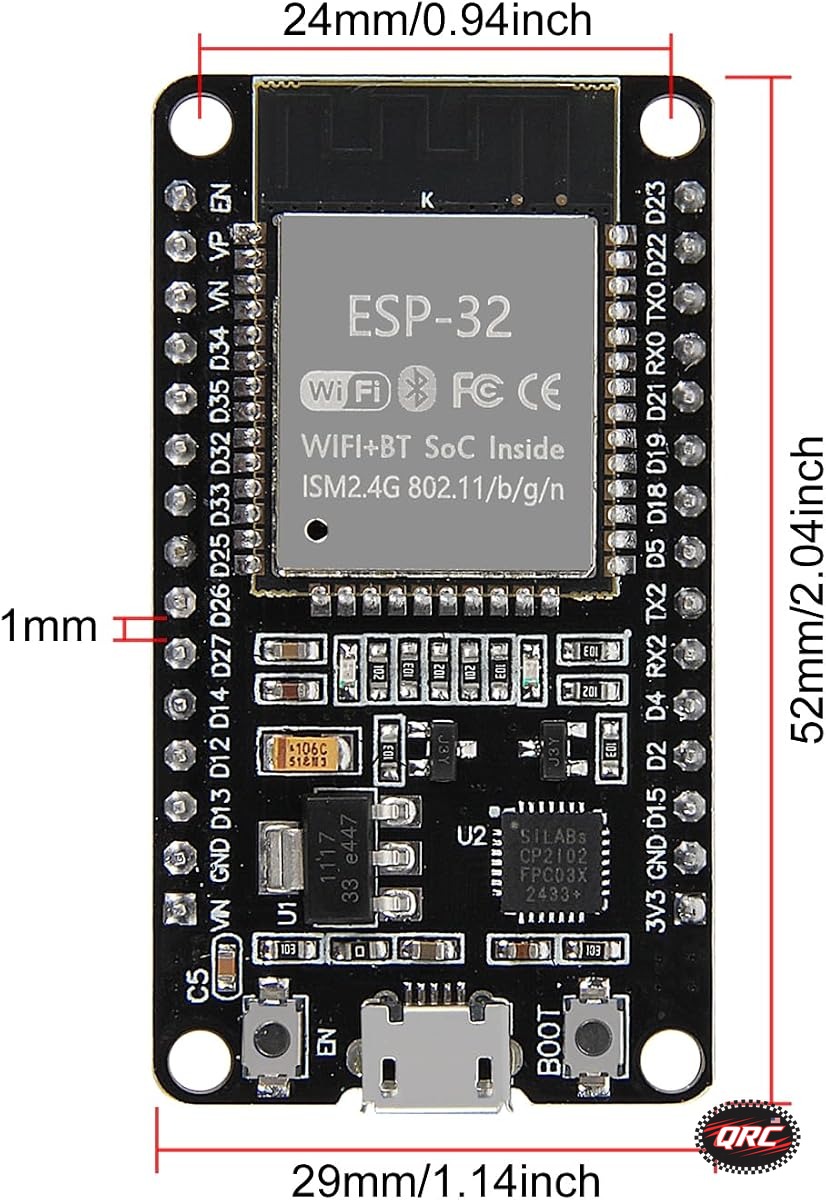
ESP8266 NodeMCU Development Board, 6-Pack: the NodeMCU board for maintaining existing ESP8266 projects. ESP32 DevKit V1 Development Board, 30-Pin WROOM-32: the ESP32 board for new projects that need more pins, RAM and Bluetooth. ESP8266 ESP-01S WiFi Module: the small ESP-01S module for serial to Wi-Fi bridges and drop in replacements.
Sources
- Espressif Technical Documents, ESP8266EX Datasheet v7.1, 2025-11-18
- Espressif ESP32 Series Datasheet v5.3
- Espressif Longevity Commitment, ESP8266 15 years from January 1, 2014
- ESPHome FAQ, ESP8266 not recommended for new projects, ESP32-C3 recommended
- ESPEasy, ESP8266 builds declared feature complete April 2025
Last updated: 2026-11-21. Search volume: not verified. Product links use the store short link form with the product ID; confirm the product slug at publish time.