
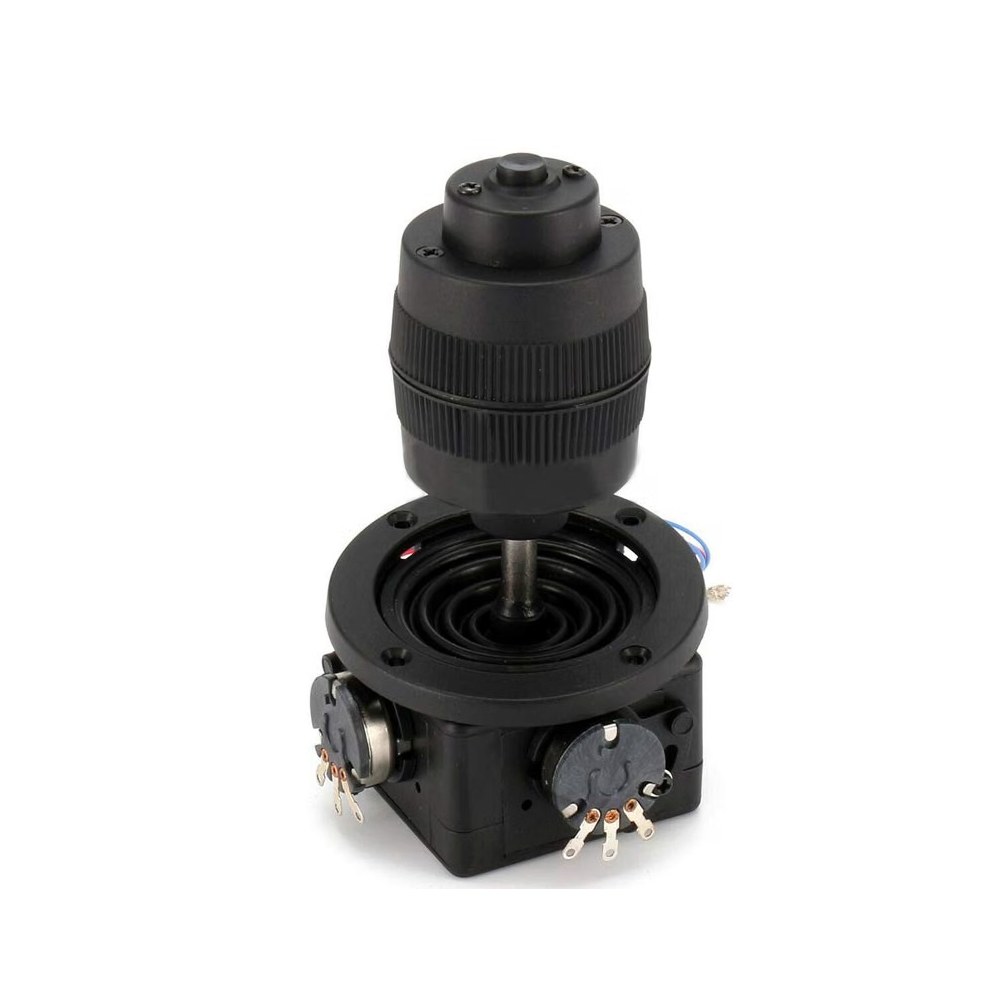
A 4-axis joystick potentiometer controls four inputs from one stick: X tilt, Y tilt, Z twist, and a momentary top button. Three 10K potentiometers report the stick position as analog voltages, so an Arduino, ESP32, or Raspberry Pi reads each axis with an analog input. It fits robot arms, pan tilt camera mounts, and simulator controls where one hand should drive several motions at once.
How do the four axes work?
The stick tilts in X and Y like a normal joystick, twists around the Z axis like a knob, and presses down on a momentary button at the top. Each of the three motions turns its own 10K potentiometer, and the button closes a switch. Your code reads three analog values and one digital input, then maps them to servos, motors, or camera movement.
What are the specs that matter?
- Three 10K potentiometers, plus or minus 20 percent, linearity plus or minus 1 percent
- 25 degree tilt range on X and Y
- 35 mm grip, 40.4 mm base, 49.6 mm wide
- Z axis potentiometer prewired: red and white reference wires, black wiper wire
- Top button on two blue wires, momentary action
What is it best used for?
Robot arms. Map X and Y to two arm joints, Z twist to the wrist or gripper rotation, and the top button to grip open and close. One stick runs the whole arm.
Pan tilt cameras. X and Y aim the camera, Z twist zooms or rolls, and the button snaps a photo or toggles recording.
Rovers. Y drives forward and back, X steers, Z twist controls a turret or arm mounted on the rover.
Simulator and RC transmitter builds. The twist axis adds a rudder or throttle channel without a second stick.
How do you wire it to Arduino or ESP32?
Connect each potentiometer to 5V and ground, with the wiper to its own analog input pin. The Z potentiometer ships prewired with red and white reference wires and a black wiper wire. Wire the two blue button wires to a digital input with a pull-up resistor. Read the analog values, center them at rest, and map the range to your servo angles or motor speeds. The 4-axis joystick potentiometer with momentary top button works with Arduino, ESP32, and Raspberry Pi boards that have analog inputs.
Frequently asked questions
Does a 4-axis joystick need analog inputs?
Yes. The three potentiometers output a varying voltage, so each axis needs one analog input. The button needs one digital input.
Can it replace two 2-axis joysticks?
For most arm and pan tilt builds, yes. The twist axis covers the third motion that would otherwise need a second stick or a knob.
What is the difference from a PS2 joystick module?
A PS2 module gives X and Y plus a button. The 4-axis stick adds the Z twist axis, which suits arms and cameras that need a third proportional motion. See the PS2 joystick module guide for the two-axis option.
Where do I find more joystick options?
Browse the Joysticks and Input Controls category for potentiometer sticks, switch sticks, and flight sticks.
Sources
- 4-Axis Joystick Potentiometer product page
- Joysticks and Input Controls category
- PS2 Joystick Module guide
Shipped fast and securely from our secure facility in New York, providing fast, high quality USA shipping.