
Every microcontroller project starts the same way: a board, a breadboard, wires, and a USB cable. This guide covers the prototyping essentials in this lineup: breadboards, jumper wires, headers, and USB-C cables, plus how to build a first circuit and which boards they pair with.
How to build a first circuit
- Seat the board. Press the board into the breadboard terminal area so its pins land in separate rows.
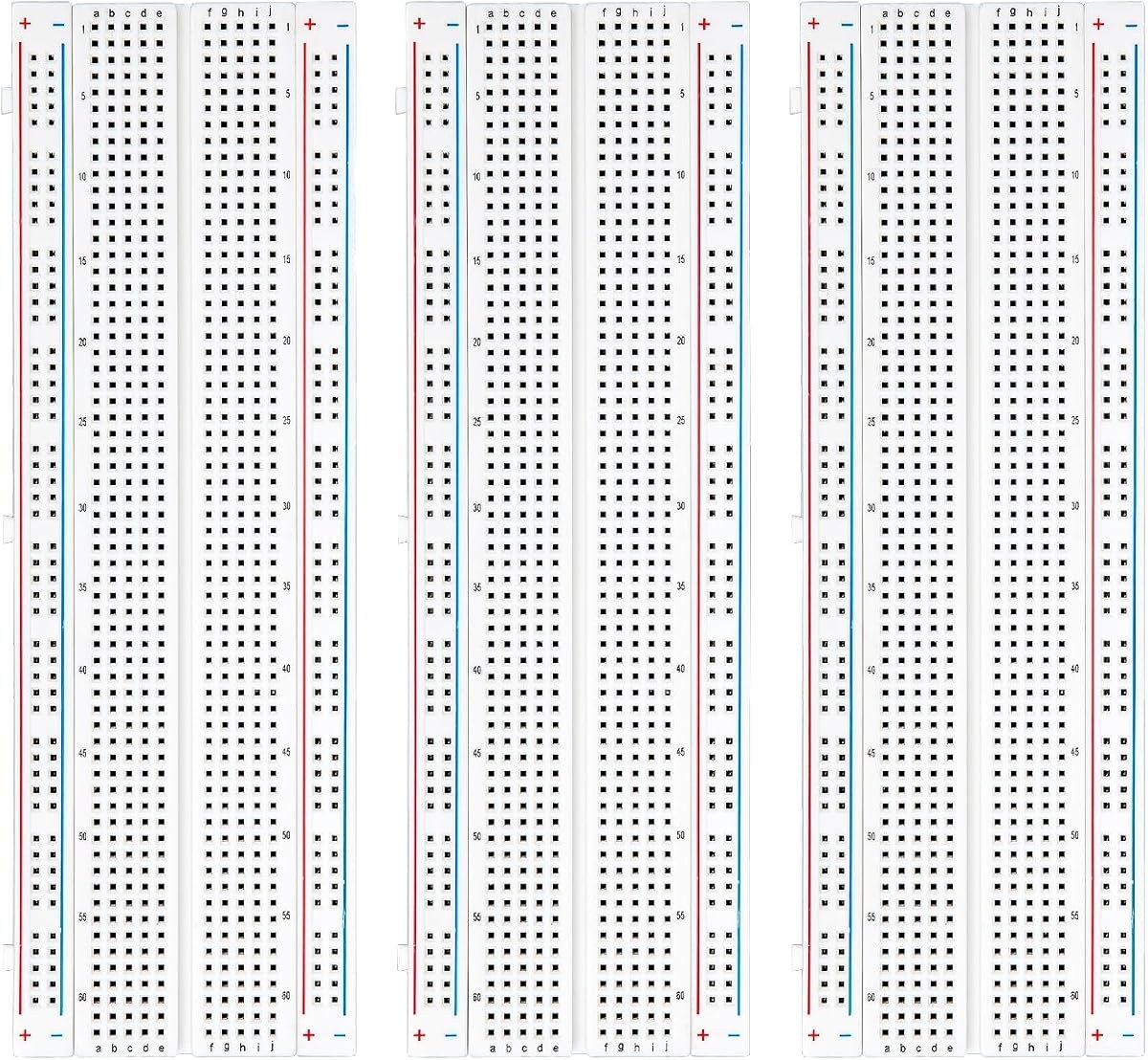
- Run power and ground. Connect power and ground along the power rails, using the printed letters, numbers, and colored rail guides.
- Add the part. Plug the sensor, LED, or module into free rows near the board, and check the pinout before wiring.
- Wire it up. Use jumper wires to connect the part to the board pins and power rails, matching colors to power, ground, and signal paths.
- Connect USB and test. Plug in the USB cable, upload a first sketch, and check the result. If it fails, rewire and try again.
Rewiring costs nothing: move parts, swap wires, and test again until the circuit works.
Breadboards: full-size and mixed kits
ELEGOO 830-point breadboard 3-pack
The ELEGOO 830-point breadboard 3-pack gives three full-size solderless breadboards. Each board has 830 tie points: a 630-point terminal area plus two 100-point distribution strips, with four power rails, printed letters and numbers, and colored rail guides. The self-adhesive back mounts a prototype on a flat surface, and side clips connect boards side by side for a larger area. The boards suit 21 to 26 AWG leads.
Solderless breadboard kit 4-pack
The solderless breadboard kit 4-pack gives four solderless breadboards in two sizes: two full-size 830-point boards and two compact 400-point boards. Each board has a white ABS body with a black printed legend and a color legend on the distribution strips, and self-adhesive tape on the back. The boards work with 20 to 29 AWG wire. Use a full-size board for a main build and a compact board for a sub-circuit.
Jumper wires: reach and connector types
ELEGOO Dupont jumper wire set
The ELEGOO Dupont jumper wire set includes 120 multicolored Dupont wires: 40 male-to-male, 40 male-to-female, and 40 female-to-female. Each 20 cm lead reaches across breadboards and nearby modules. Peel wires from the 40-wire ribbons to match a project layout. The 2.54 mm connections fit common 0.1 in headers.
Male-to-male jumper wires, 10 cm
The male-to-male jumper wires 120-piece includes 120 male-to-male wires in three 40-pin separable ribbons. Each cable is 10 cm of 12-core pure copper wire in 10 colors, with 2.54 mm Dupont connectors and brass nickel-plated terminals. The shorter length suits tight layouts. Pick this set when wiring stays on one breadboard.
Headers: standard, stacking, and Pico
Headers are what connect boards to breadboards, sockets, and each other. The pin header set 20-piece gives 20 breakaway strips, 10 male and 10 female, each with 40 pins at 2.54 mm pitch. Score and snap them to any length needed. The pin header set 40-piece doubles that to 40 strips, 20 male and 20 female. Male headers plug into a breadboard or socket, and female headers accept male pins.
The stacking female header set is the stacking option: 8 extra-tall female stacking headers, 2×20 with 40 pins and 12 mm pins, with gold-color plated contacts, PA6T insulation, and a maximum contact resistance of 20 mOhm, compatible with Raspberry Pi A+, B+, Pi 2, Pi 3, and Pi 4. Solder one to a HAT so it plugs onto the GPIO header while leaving pins available above.
For Pico builds, the GPIO extender header kit gives 14 headers with stacking female headers in three pin lengths, 12 mm, 10.7 mm, and 5.5 mm, plus 2×20, 1×20, and 1×3 headers, gold plated, for Raspberry Pi, Pi Zero, and Pico. The pin header set 30-piece for Pico gives 30 male pin headers in 10 sets for the Raspberry Pi Pico, at 2.54 mm pitch, with 20-pin and 3-pin male-to-male headers in copper and plastic.
USB-C cables: short, braided, and data rated
All three packs are short 1 ft USB-A to USB-C cables rated for 480 Mbps data over USB 2.0 and charging up to 3A. The short length keeps the bench tidy. The short USB-C cable 1ft 2-pack gives two nylon braided cables rated for over 20000 bends. Note that these cables do not support video or media display: they are charging and data cables, not display cables. The short USB-C cable 1ft 3-pack gives three braided cables with 3A charging up to 18W, QC 3.0 and 2.0, a 56K ohm resistor, and over 10000 bend tests. The short USB-C cable 1ft 5-pack gives five cables with 3A charging up to 60W, a 56K ohm resistor, and over 10000 bend tests. Match the pack size to the boards on the bench.
What pairs with Pico and ESP32 boards
These essentials pair directly with the boards in this lineup. The Raspberry Pi Pico 2-pack gives two RP2040 boards with 26 GPIO pins for breadboard builds. The HiLetgo ESP32 38-pin 3-pack gives three 38-pin narrow ESP32 boards with USB-C and the CP2102 chip that program over the short USB-C cables above. One breadboard, one wire set, one header set, and one cable per board is a complete bench for a first project.
Bench checklist
- Breadboard: the ELEGOO 830-point breadboard 3-pack or the solderless breadboard kit 4-pack.
- Wires: the ELEGOO Dupont jumper wire set or the male-to-male jumper wires 120-piece.
- Headers: the pin header set 20-piece, the pin header set 40-piece, the stacking female header set, the GPIO extender header kit, or the pin header set 30-piece for Pico.
- Cable: the short USB-C cable 1ft 2-pack, the short USB-C cable 1ft 3-pack, or the short USB-C cable 1ft 5-pack.
- Board: the Raspberry Pi Pico 2-pack or the HiLetgo ESP32 38-pin 3-pack.
Further reading
For board picks to pair with this bench, read the best Raspberry Pi Pico RP2040 boards guide, ESP32 38-pin boards compared, and Raspberry Pi Pico vs Pico W vs Pico 2.
Related guides
Orders earn QRC Rewards points.
Shipped fast and securely from our secure facility in New York, providing fast, high quality USA shipping.