
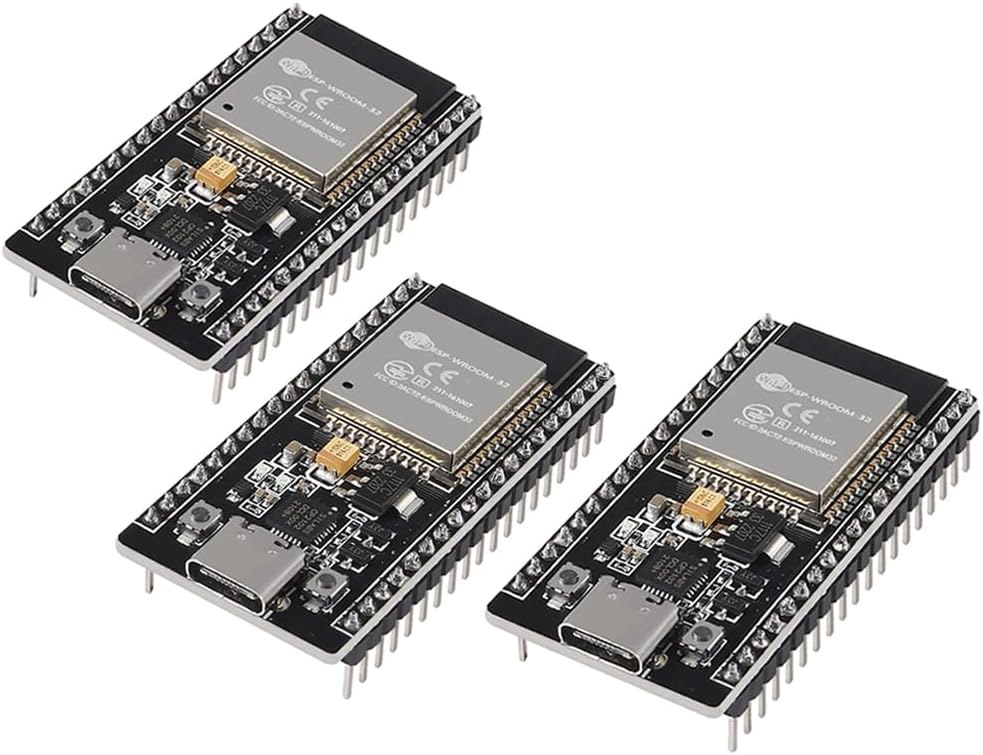
Most ESP32 starter projects start with the same shape of board: 38 pins, a USB-C port, and WiFi plus Bluetooth on one module. The boards in this guide share that shape, but they differ in the details that decide how easy a build is. Some ship with breakout adapter boards, some use the CP2102 USB to serial chip, one carries 8 MB of flash, and one is a bare solder-down module with no USB port at all. This guide compares them side by side using the listed specifications, so you can pick the board that fits the project instead of guessing.
All of the development boards here use a narrow width that connects to a breadboard very well, and all of them list 2.4 GHz WiFi and Bluetooth dual-mode with STA, AP, and STA plus AP modes and common AT commands. The choice comes down to pack size, the USB chip, the breakout style, and flash size.
Comparison table
| Board | Pins and USB | Wireless | Flash and processor | Breakout and extras |
|---|---|---|---|---|
| ESP32 38-pin 3-pack with breakout adapters | 38 pins, narrow, USB-C | 2.4 GHz WiFi and Bluetooth dual-mode | Not stated | Breakout adapter per board, each pin to two |
| HiLetgo ESP32 38-pin 3-pack | 38 pins, narrow, USB-C, CP2102 | 2.4 GHz WiFi and Bluetooth dual-mode | Not stated | UART, SPI, I2C, PWM, DAC, ADC |
| ESP32 38-pin narrow 3-pack with breakout boards | 38 pins, narrow, USB-C | AP, STA, and AP plus STA modes | Not stated | Breakout board per board, each pin to two, Lua |
| ESP32-DevKitC-32 6-pack | 38 pins, narrow, USB-C | 2.4 GHz WiFi and Bluetooth dual-mode | Not stated | UART, SPI, I2C, PWM, DAC, ADC, 6 boards |
| ESP32-DevKitC-32E 2-pack | 38 pins, USB-C | WiFi and Bluetooth 5 | 8 MB flash, 240 MHz dual-core, 38 GPIO pins with 10 RTC | ESP32-WROOM-32E module, rated minus 40 C to 85 C |
| ESP32 screw terminal breakout board 3-pack | 38 pins, screw terminals, 3.5 mm pitch | None, breakout only, module not included | None | Four-row pin sockets for 0.9 in or 1.0 in modules |
| ESP32-WROOM-32D module 5-pack | Solder-down module, no USB stated | WiFi, Bluetooth, and BLE | 4 MB external SPI flash, ESP32-D0WD, 40 MHz crystal | Onboard antenna, sleep current under 5 uA |
The 38-pin narrow boards
ESP32 38-pin 3-pack with breakout adapters
The ESP32 38-pin 3-pack with breakout adapters pairs each of its three narrow 38-pin USB-C boards with a breakout terminal adapter board. The breakout board expands one GPIO pin to two, so every pin can be reused, on a double-layer board wired on both sides for a stable connection. Pick this pack for a second connection point on every pin.
HiLetgo ESP32 38-pin 3-pack with CP2102
The HiLetgo ESP32 38-pin 3-pack is the plain board version of the same idea: three 38-pin narrow boards with a USB-C interface and the CP2102 USB to serial chip. Interfaces include UART, SPI, I2C, PWM, DAC, and ADC, and the boards offer more functions than 30-pin modules. The narrow width leaves breadboard rows free on both sides. Pick this pack when you want the board alone and plan to wire straight into a breadboard.
ESP32 38-pin narrow 3-pack with breakout boards
The ESP32 38-pin narrow 3-pack with breakout boards also pairs three narrow boards with breakout boards that expand one GPIO pin to two. It lists support for Lua programs and the three wireless modes AP, STA, and AP plus STA. Fit note: the breakout boards fit 38-pin narrow-version ESP32 boards without mounting holes only, and do not fit the ESP32 DevKit V1 version. Check pin width before ordering.
DevKitC boards: standard and 32E
ESP32-DevKitC-32 6-pack
The ESP32-DevKitC-32 6-pack gives six 38-pin narrow USB-C boards with the same WiFi and Bluetooth dual-mode base and the same UART, SPI, I2C, PWM, DAC, and ADC interfaces. Six boards cover a classroom set, a multi-node sensor build, or spares across several projects. Pick this pack when you need several identical boards and do not need the 8 MB flash upgrade.
ESP32-DevKitC-32E 2-pack with 8 MB flash
The ESP32-DevKitC-32E 2-pack is built around the ESP32-WROOM-32E module with upgraded 8 MB flash for IoT data and over-the-air updates. The 240 MHz dual-core processor runs WiFi and BLE plus sensors together, with 38 GPIO pins, 10 of them RTC, supporting SPI, I2C, and UART. It lists Bluetooth 5, works with Arduino IDE, MicroPython, and Espressif IDF, and is rated from minus 40 C to 85 C for outdoor and automated systems.
Breakout adapters vs screw terminals
Breakout adapter boards and screw terminal boards solve different wiring problems. The adapter boards in the ESP32 38-pin 3-pack with breakout adapters and ESP32 38-pin narrow 3-pack with breakout boards packs expand each pin to two connection points, The ESP32 screw terminal breakout board 3-pack takes the other route: seat a 38-pin ESP32-DevKitC module in the pin sockets and land wires in screw terminals at 3.5 mm pitch, with no soldering to the module. Its four-row sockets accept 0.9 in or 1.0 in modules. The ESP32 module is not included. Use adapters for breadboard work, screw terminals for fixed wiring.
Module vs development board
The ESP32-WROOM-32D module 5-pack is not a development board. It is five bare ESP32-WROOM-32D modules built around the ESP32-D0WD core with 4 MB of external SPI flash, a 40 MHz crystal, and an onboard antenna. Sleep current of the ESP32 chip is less than 5 uA, which suits battery powered and wearable electronics. Two limits matter. First, the integrated SPI flash connects to GPIO6 through GPIO11, and those six pins cannot be used as regular GPIOs. Second, a bare module needs a carrier board, so prototype on a development board first.
First project: blink, then WiFi scan
Plug the board into a breadboard, connect USB-C, and run a blink sketch in the Arduino IDE or MicroPython. A blinking LED proves the board programs and the toolchain works. Next, run a WiFi scan to confirm wireless works. Only then add sensors, displays, or motors. This two-step start catches setup problems early.
Which board to buy
- First board, known USB chip: HiLetgo ESP32 38-pin 3-pack.
- Pin-doubling breakout boards included: ESP32 38-pin 3-pack with breakout adapters or the ESP32 38-pin narrow 3-pack with breakout boards (check the fit note).
- Several identical boards: ESP32-DevKitC-32 6-pack.
- 8 MB flash, Bluetooth 5, wide temperature rating: ESP32-DevKitC-32E 2-pack.
- Fixed wiring, no soldering to the module: ESP32 screw terminal breakout board 3-pack.
- Finished soldered product, prototype first: ESP32-WROOM-32D module 5-pack.
Further reading
For a wider look at ESP32 boards, see the best ESP32 development boards guide and which ESP32 board to buy. For the newer WiFi 6 and Zigbee option, read ESP32-C6 vs classic ESP32. For the breadboards, jumper wires, and cables that complete the bench, read breadboard prototyping essentials.
Related guides
Orders earn QRC Rewards points.
Shipped fast and securely from our secure facility in New York, providing fast, high quality USA shipping.