
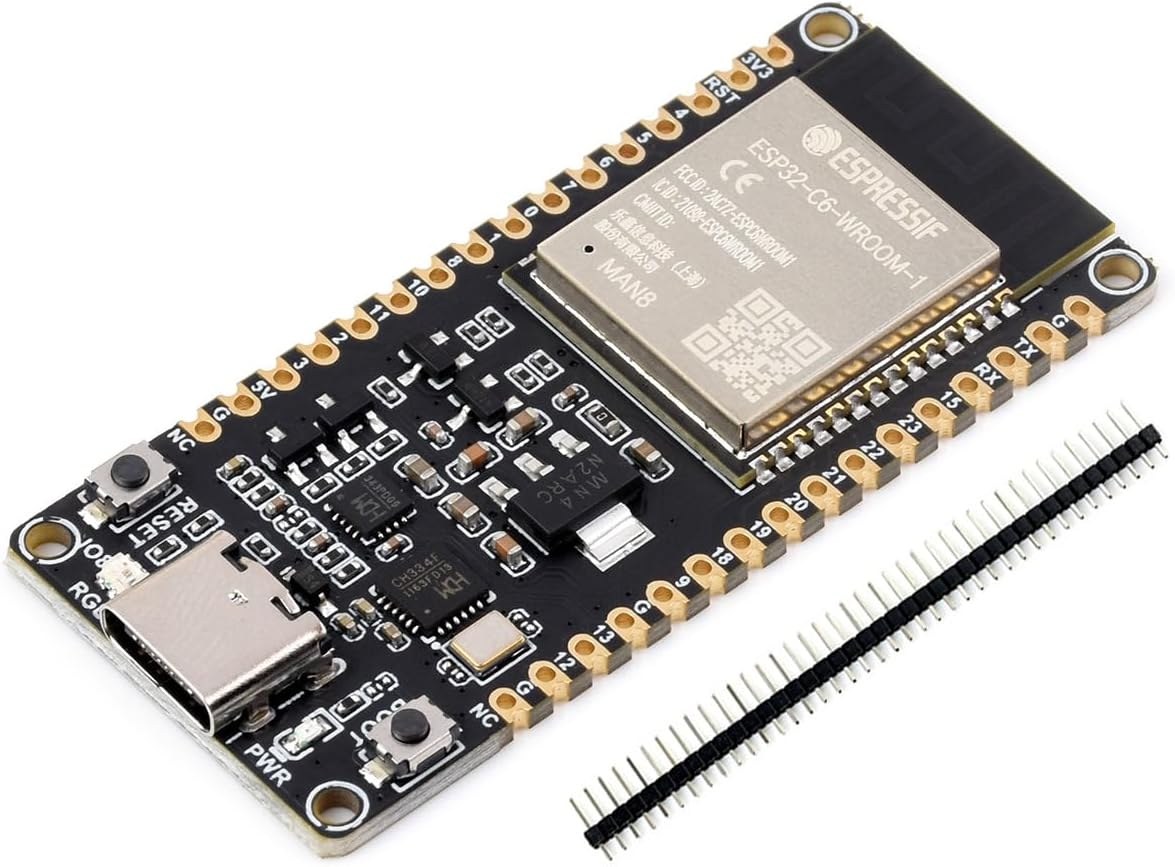
The classic ESP32 is a proven board for WiFi and Bluetooth projects. The ESP32-C6 adds newer radios to that formula: WiFi 6, Bluetooth 5, and IEEE 802.15.4 for Zigbee 3.0 and Thread. This guide compares the Waveshare ESP32-C6 development board against the classic 38-pin ESP32 boards, using the listed specifications, and explains when the C6 wins and when a classic board is the better pick.
The ESP32-C6 board
The Waveshare ESP32-C6 development board adopts the ESP32-C6-WROOM-1-N8 module with a RISC-V 32-bit single-core processor running up to 160 MHz and 8 MB of built-in flash. It integrates WiFi 6, Bluetooth 5, and IEEE 802.15.4 wireless communication for Zigbee 3.0 and Thread. Rich peripherals include SPI, UART, I2C, I2S, LED PWM, and SDIO, with a pinout compatible with the ESP32-C6-DevKitC-1-N8 development board. Onboard CH343 and CH334 USB hub chips support USB and UART development at the same time through a USB-C port. Online examples and tutorials are provided for the ESP-IDF development environment.
The headline difference is the radio set. WiFi 6 is the newer WiFi standard on this board, and Zigbee and Thread are mesh protocols that classic ESP32 boards in this lineup do not list. If a project needs a Zigbee or Thread mesh, the C6 is the board in this lineup that lists those radios. If a project only needs standard WiFi and Bluetooth, the classic boards cover it.
The classic ESP32 boards
The HiLetgo ESP32 38-pin 3-pack gives three 38-pin narrow boards with a USB-C interface and the CP2102 USB to serial chip. Each board lists 2.4 GHz WiFi and Bluetooth dual-mode, STA, AP, and STA plus AP modes, and common AT commands, with UART, SPI, I2C, PWM, DAC, and ADC interfaces. The narrower width connects to a breadboard very well. This is the standard classic ESP32 setup: a proven radio pair, a known USB chip, and a breadboard-friendly shape.
The ESP32-DevKitC-32E 2-pack is the stronger classic board. It is built around the ESP32-WROOM-32E module with upgraded 8 MB flash for IoT data and over-the-air updates, a 240 MHz dual-core processor, 38 GPIO pins with 10 RTC, and Bluetooth 5. It works with Arduino IDE, MicroPython, and Espressif IDF on Windows, Mac, and Linux, and it is rated from minus 40 C to 85 C. Against the C6, the 32E offers two cores at 240 MHz and the same 8 MB of flash, but it lists no Zigbee or Thread radio and no WiFi 6.
C6 vs classic: specification comparison
| Specification | ESP32-C6 board | Classic ESP32-DevKitC-32E | Classic HiLetgo 38-pin board |
|---|---|---|---|
| Processor | RISC-V 32-bit single-core, up to 160 MHz | 240 MHz dual-core | Not stated |
| Flash | 8 MB built-in | 8 MB | Not stated |
| WiFi | WiFi 6 | WiFi | 2.4 GHz WiFi |
| Bluetooth | Bluetooth 5 | Bluetooth 5 | Bluetooth dual-mode |
| Zigbee and Thread | Yes, IEEE 802.15.4, Zigbee 3.0 and Thread | Not stated | Not stated |
| USB | USB-C, CH343 and CH334 hub chips | USB-C | USB-C, CP2102 |
| Peripherals | SPI, UART, I2C, I2S, LED PWM, SDIO | SPI, I2C, UART, 38 GPIO pins with 10 RTC | UART, SPI, I2C, PWM, DAC, ADC |
| Development | ESP-IDF examples and tutorials | Arduino IDE, MicroPython, ESP-IDF | Not stated |
When the C6 wins
- Zigbee or Thread projects. The C6 lists IEEE 802.15.4 with Zigbee 3.0 and Thread. Neither classic board in this comparison lists those radios, so a mesh project starts with the C6.
- WiFi 6 networks. The C6 lists WiFi 6, while the classic boards list 2.4 GHz WiFi. On a WiFi 6 network, the C6 is the board that lists the newer standard.
- Mesh and smart home builds. Zigbee and Thread are the radios used by many smart home devices, and the C6 combines them with WiFi 6 and Bluetooth 5 on one board with 8 MB of flash.
- USB and UART at the same time. The onboard CH343 and CH334 hub chips support USB and UART development at the same time through one USB-C port.
When a classic ESP32 wins
- Two cores at 240 MHz. The 32E lists a 240 MHz dual-core processor, against the single-core RISC-V processor at up to 160 MHz on the C6. For builds that run WiFi and BLE plus sensors together, the 32E lists the stronger processor setup.
- Standard WiFi and Bluetooth projects. A sensor node, a display project, or a simple connected build needs 2.4 GHz WiFi and Bluetooth, which the HiLetgo ESP32 38-pin 3-pack lists. No Zigbee or Thread radio is needed, so the classic board is the simpler pick.
- Three boards for several projects. The HiLetgo pack includes three boards, which suits spares, multi-node builds, and learning without tying up one board.
- Wide temperature range. The 32E is rated from minus 40 C to 85 C for outdoor and automated systems. The C6 listing states no temperature rating, so the 32E is the listed pick for harsh environments.
- Arduino IDE and MicroPython. The 32E lists Arduino IDE, MicroPython, and ESP-IDF. The C6 listing points to ESP-IDF examples and tutorials, so check your toolchain before choosing the C6 for an Arduino IDE project.
Getting started with the C6
Start with the ESP-IDF examples that the listing mentions. Bring up WiFi 6 for a connected sensor first, and confirm the board connects and reports data. Then run a Zigbee or Thread example for a mesh project. The USB-C port handles USB and UART development at the same time, so debugging stays connected while the board runs. As with any new board, confirm the basics before adding sensors or mesh nodes: power, programming, and one working wireless example.
The short answer
Choose the Waveshare ESP32-C6 development board when the project needs Zigbee, Thread, or WiFi 6. Choose the ESP32-DevKitC-32E 2-pack when the project needs two cores at 240 MHz, 8 MB flash, and a wide temperature rating on standard WiFi and Bluetooth 5. Choose the HiLetgo ESP32 38-pin 3-pack for everyday WiFi and Bluetooth builds where three breadboard-friendly boards and a CP2102 USB chip are the right fit. Match the radio set to the project first, and the rest of the choice follows.
Further reading
For more on the compact ESP32-C family, read the XIAO ESP32-C3, C6, S3, and C5 guide. For the full classic lineup, read ESP32 38-pin boards compared.
Related guides
Orders earn QRC Rewards points.
Shipped fast and securely from our secure facility in New York, providing fast, high quality USA shipping.