
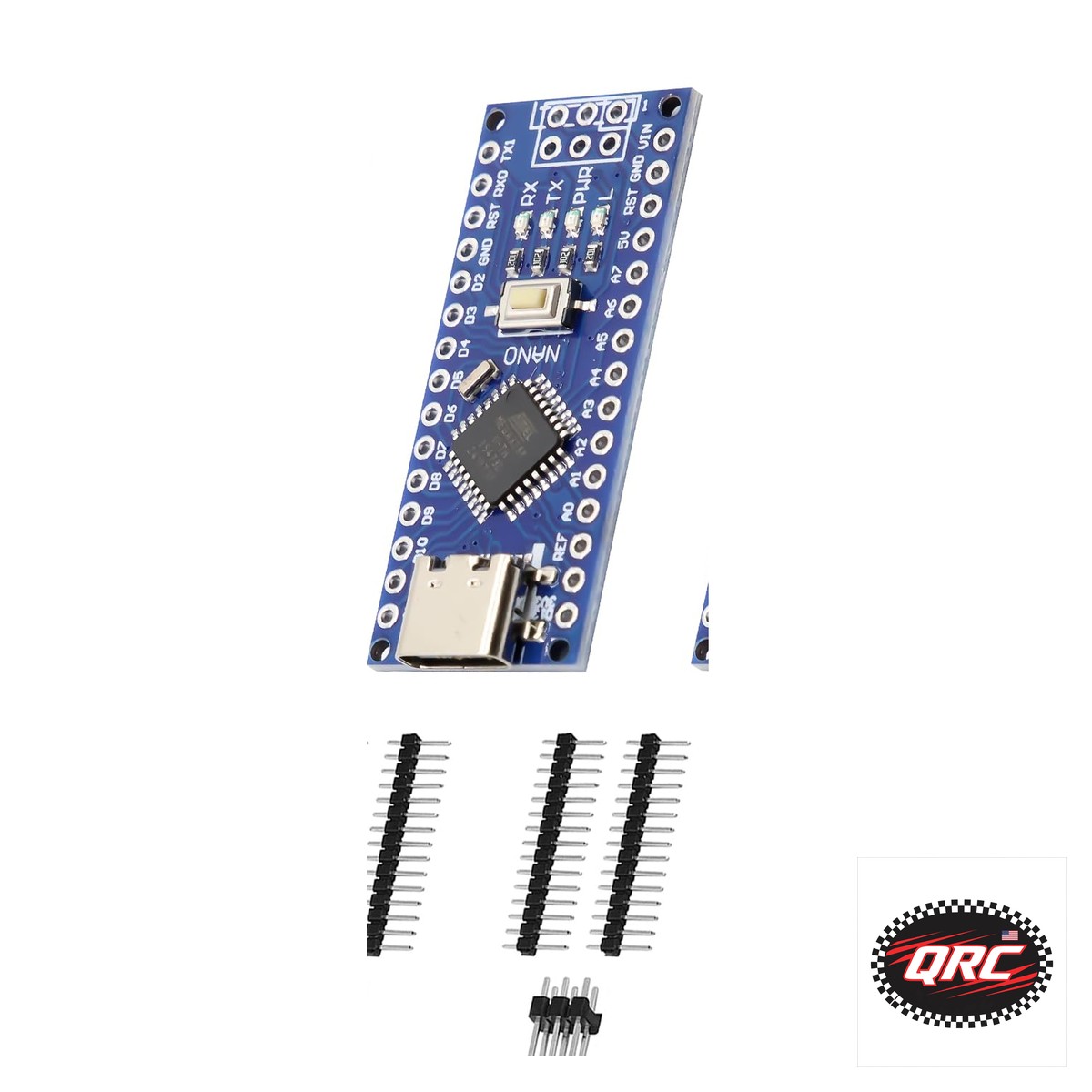
Nano V3.0 USB-C Guide: ATmega328P Board for Arduino IDE
The Nano V3.0 is a compact Arduino IDE board with an ATmega328P running at 16MHz, 32KB flash, and 2KB RAM. This version swaps the classic Mini-USB port for USB-C, so no Mini-USB cable is needed. Install the CH340G driver first, then the board shows up in the IDE. The single costs $8.49, and the 3-pack costs $17.99.
Quick facts
| Fact | Value |
|---|---|
| Chip | ATmega328P, 16MHz |
| Memory | 32KB flash, 2KB RAM |
| USB | USB-C, CH340G |
| Voltage | 5V |
| Weight | 40 g per board |
| Single / 3-pack | $8.49 / $17.99 |
What is on the board?
The board carries an ATmega328P at 16MHz with 32KB flash and 2KB RAM, a CH340G USB chip, and a USB-C port, at 5V and 40 g.
Pin headers are included but unsoldered, so solder them for breadboard use or leave them off for a soldered install.
The board works with Windows, Mac, and Linux, and with the Arduino IDE.
Why USB-C?
The USB-C port is the difference from the classic Mini-USB Nano, per the listing, so no Mini-USB cable is needed.
One USB-C cable covers the Nano and most modern boards and phones, which cuts one more cable from the bench drawer.
The 3-pack includes 1 USB-C cable, so a first order has the cable in the box.
How do you set it up?
Install the CH340G driver first, then the board shows up in the Arduino IDE.
Open the IDE, pick the Nano board and the port the board appears on, and upload a sketch.
The driver guide linked below walks through the CH340 install on each operating system.
Single or 3-pack?
The single board suits one project, and the 3-pack suits multi-board builds, spares, or a classroom set.
The 3-pack costs less than three single boards and includes 1 USB-C cable, with one set of pin headers per board.
Both options carry the same board: ATmega328P, CH340G, USB-C, 32KB flash, and 2KB RAM.
What did we check on the bench?
We checked the listing states ATmega328P, CH340G, 5V, 16MHz, USB-C, 2KB RAM, 32KB flash, and 40 g.
We checked the 3-pack listing states 3 boards and 1 USB-C cable, with one set of pin headers per board.
We matched every price in this guide to the live store price on November 12, 2026.
How do you get the Nano running?
- Install the CH340G driver for your operating system.
- Plug the board into the computer with a USB-C cable.
- Open the Arduino IDE and pick the Nano board and the port the board appears on.
- Upload the Blink example sketch.
- Confirm the onboard LED blinks, which proves the toolchain, driver, and board all work.
Parts that fit this guide
Shipped fast and securely from our secure facility in New York, providing fast, high quality USA shipping.
Nano V3.0 Development Board, ATmega328P, CH340G, USB-C, Single ($8.49)
Nano V3.0 single board at $8.49. ATmega328P, CH340G, USB-C, 32KB flash, 2KB RAM, 1 board.
Nano V3.0 Development Board, ATmega328P, CH340G, USB-C, 3-Pack ($17.99)
Nano V3.0 3-pack at $17.99. Three boards and 1 USB-C cable, one set of pin headers per board.
Related parts: ELEGOO UNO R3 Microcontroller Board, ATmega328P + ATmega16U2, with USB Cable: ELEGOO UNO R3 board for larger Arduino projects; HiLetgo Game Joystick Sensor Module, PS2, 2-Axis with Pushbutton: PS2 joystick module for Nano controller projects.
Shop the full range: Arduino Compatible Boards at Quality RC Parts. See also: Related guide.
Read the companion version of this guide on MTSUAV.
Frequently asked questions
Do I need a driver for the Nano?
Yes. Install the CH340G driver first, then the board shows up in the Arduino IDE.
Does the 3-pack include a cable?
Yes. The 3-pack includes 3 boards and 1 USB-C cable, with one set of pin headers per board.
Are the pin headers soldered on?
No. Pin headers are included but unsoldered, one set per board.
Does this Nano use Mini-USB?
No. This version uses a USB-C port, which the listing states is the difference from the classic Mini-USB Nano.
Sources
Last updated: November 12, 2026.