
How to Use NodeMCU ESP8266 with a Built-In OLED Display
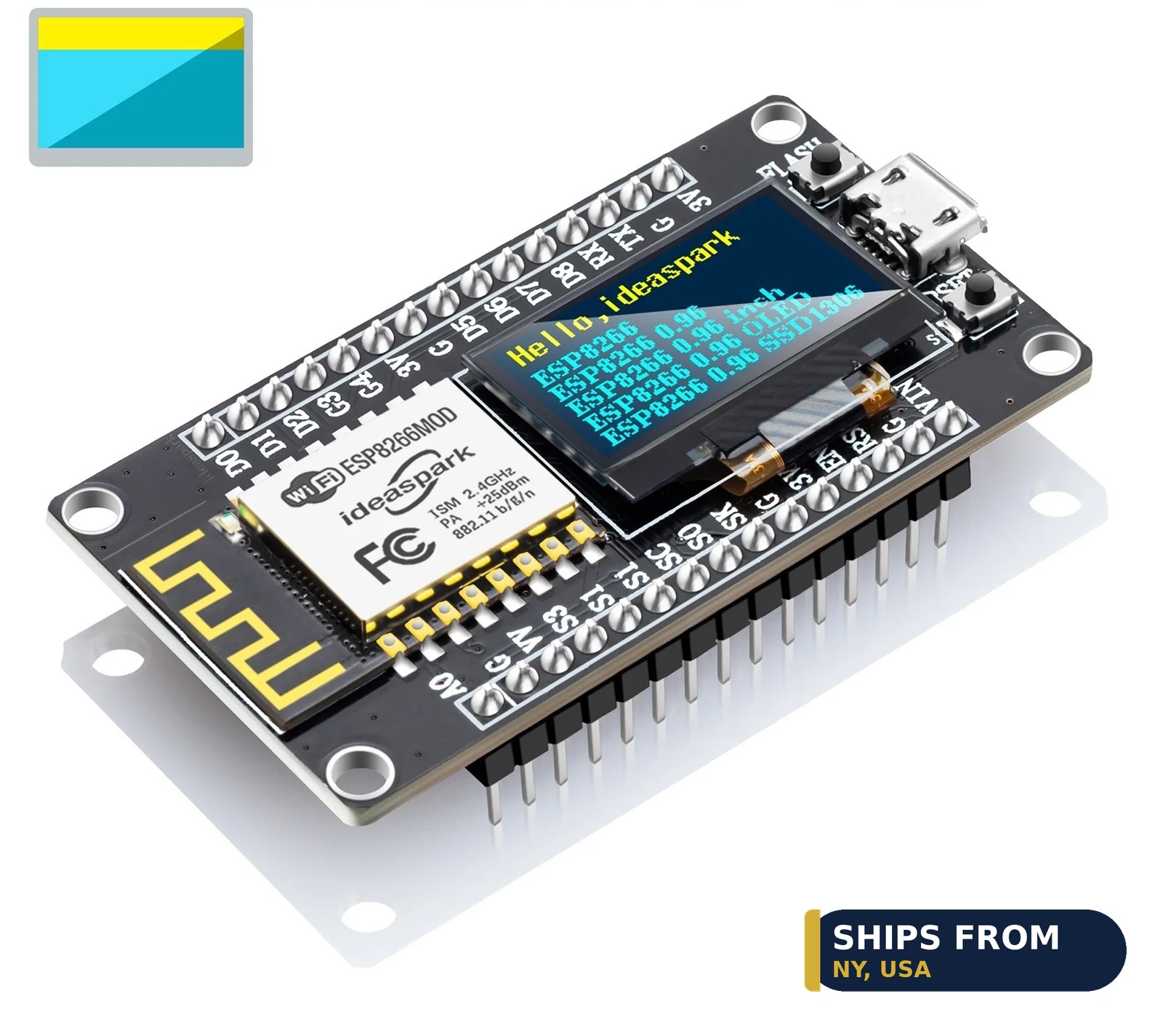
Use the NodeMCU ESP8266 board when you want WiFi and a display on one board. It carries an ESP-12E chip and a built-in 0.96 inch SSD1306 OLED display. The board costs from $11.37, with white, yellow-blue, or blue display colors. A DHT22 sensor adds temperature and humidity readings to the screen.
Quick facts
| Fact | Value |
|---|---|
| Chip | ESP-12E, ESP8266 |
| Display | 0.96 inch SSD1306 OLED, built in |
| USB-serial | CH340, Micro USB |
| Buttons | FLASH and RESET |
| Board price | From $11.37, by display color |
| DHT22 sensor | 0 to 100% RH, -40 to 80C |
What is on the NodeMCU ESP8266 board?
The board carries an ESP-12E chip with WiFi and a built-in 0.96 inch SSD1306 OLED display. The display sits on the board, so no wiring is needed for it.
It uses a CH340 USB-serial chip over Micro USB. FLASH and RESET buttons sit on the board for programming and restarts.
The board works with the Arduino IDE. It costs from $11.37, with white, yellow-blue, or blue display colors.
How do you show sensor readings on the OLED?
Wire the DHT22 sensor to the board and read it in the sketch. The sensor reads 0 to 100% relative humidity and -40 to 80C.
It runs on 3.3V to 5.5V with a single-bus output. That range suits the NodeMCU board with no extra parts.
Draw the readings on the built-in OLED display. Update it once per loop so the numbers stay readable.
How do you add a larger TFT display?
The TFT LCD module gives an IPS SPI display in 0.96 to 2.8 inch sizes. It shows 65K colors with ST7735, ST7789, or ILI9341 drivers.
Prices run from $5.83 for the 0.96 inch size to $10.92 for the 2.8 inch size. Pick the size that fits your case.
The built-in OLED suits text readings. The TFT suits graphs and color gauges that need more pixels.
How do you connect the board to WiFi?
Load a WiFi sketch from the Arduino-ESP32 examples and set your network name and password. The ESP-12E chip joins the network on boot.
Test the link at 2m from the router first. Move the board farther only after the near link runs clean.
The board costs from $11.37, so keep one spare for bench tests. A spare board saves a project when a pin fails.
How do you power the board and its sensors?
Power the board over its Micro USB port from a stable 5V supply. A laptop USB port suits bench work.
The DHT22 sensor takes 3.3V to 5.5V from the board pins. The TFT display takes its supply from the board SPI pins.
Keep the sensor wires short to avoid noise on the readings. A short run gives steadier numbers than a long run.
How the options compare
| Part | Key spec | Price |
|---|---|---|
| NodeMCU, blue OLED | ESP-12E, 0.96 inch OLED built in | $11.37 |
| NodeMCU, white OLED | ESP-12E, 0.96 inch OLED built in | $11.46 |
| NodeMCU, yellow-blue OLED | ESP-12E, 0.96 inch OLED built in | $11.46 |
| DHT22 sensor | 0 to 100% RH, -40 to 80C | $4.99 |
| TFT display, 0.96 inch | IPS SPI, 65K colors | $5.83 |
| TFT display, 2.0 inch | IPS SPI, 65K colors | $9.72 |
| TFT display, 2.8 inch | IPS SPI, 65K colors | $10.92 |
How do you show WiFi sensor data on the OLED?
- Connect the board to your computer over Micro USB.
- Pick the NodeMCU board in the Arduino IDE.
- Wire the DHT22 data pin to a free GPIO pin.
- Load a sketch that reads the sensor and draws to the OLED.
- Join the board to your WiFi network with your network name and password.
- Check that the display shows temperature, humidity, and the WiFi link.
Parts that fit this guide
In-stock parts ship from the New York, USA warehouse in 1-2 business days. Prices below are the live store prices we verified on November 10, 2026.
NodeMCU ESP8266 Development Board with 0.96″ OLED Display, ESP-12E, Micro USB ($11.37)
NodeMCU ESP8266 board at $11.37. It carries an ESP-12E chip with a built-in 0.96 inch SSD1306 OLED display.
DHT22 / AM2302 Digital Temperature & Humidity Sensor Module ($4.99)
DHT22 sensor at $4.99. It reads 0 to 100% relative humidity and -40 to 80C on 3.3V to 5.5V.
TFT LCD Display Module, IPS SPI, 0.96-2.8 inch, ST7735/ST7789/ILI9341 ($5.83)
TFT LCD display at $5.83 to $10.92 by size. It gives an IPS SPI display in 0.96 to 2.8 inch sizes with 65K colors.
Shop the full range: ESP32 and ESP8266 at Quality RC Parts. See also: Related guide.
Frequently asked questions
Does the NodeMCU board include a display?
Yes. It has a built-in 0.96 inch SSD1306 OLED display, with white, yellow-blue, or blue colors.
What chip does the board use?
An ESP-12E chip with WiFi, a CH340 USB-serial chip, and Micro USB.
Can I add a larger display?
Yes. The TFT LCD module runs from $5.83 for 0.96 inch to $10.92 for 2.8 inch.
What sensor works with the built-in OLED?
The DHT22 sensor at $4.99. It reads 0 to 100% relative humidity and -40 to 80C.
Sources
Last updated: November 10, 2026.