
FPV drones crash. That is the job, and it is why the filament matters as much as the design. A frame or mount printed in the wrong material cracks on the first hard landing, while the same part printed in the right material flexes, absorbs the hit, and flies again. The best filament FPV drone builders use depends on the part, because frames, mounts, and guards fail in different ways. This guide compares PLA+, PETG, and HT-PLA Pro for FPV drone frames and mounts, and tells you which one to pick for each part.
Three things decide the pick. Impact resistance decides whether a part survives a crash. Layer adhesion decides whether it splits along a layer line. Heat resistance decides whether it softens near motors and speed controllers. No single filament wins all three, so the right answer is to match the filament to the part. Print the rigid parts in one material, the flexing parts in another, and the hot parts in a third.
Best Filament FPV Drone Frames: PLA+
PLA+ is the default pick for FPV drone frames and mounts. It is tougher than standard PLA, less brittle, and holds up better under impact, with stronger layer adhesion. That makes it right for camera mounts, GoPro mounts, antenna mounts, arm brackets, and housings. It prints at a nozzle temperature of 200 to 230C and a bed temperature of 55 to 65C, at speeds up to 300mm/s, so it prints almost like PLA. If you only stock one filament for FPV parts, stock PLA+.
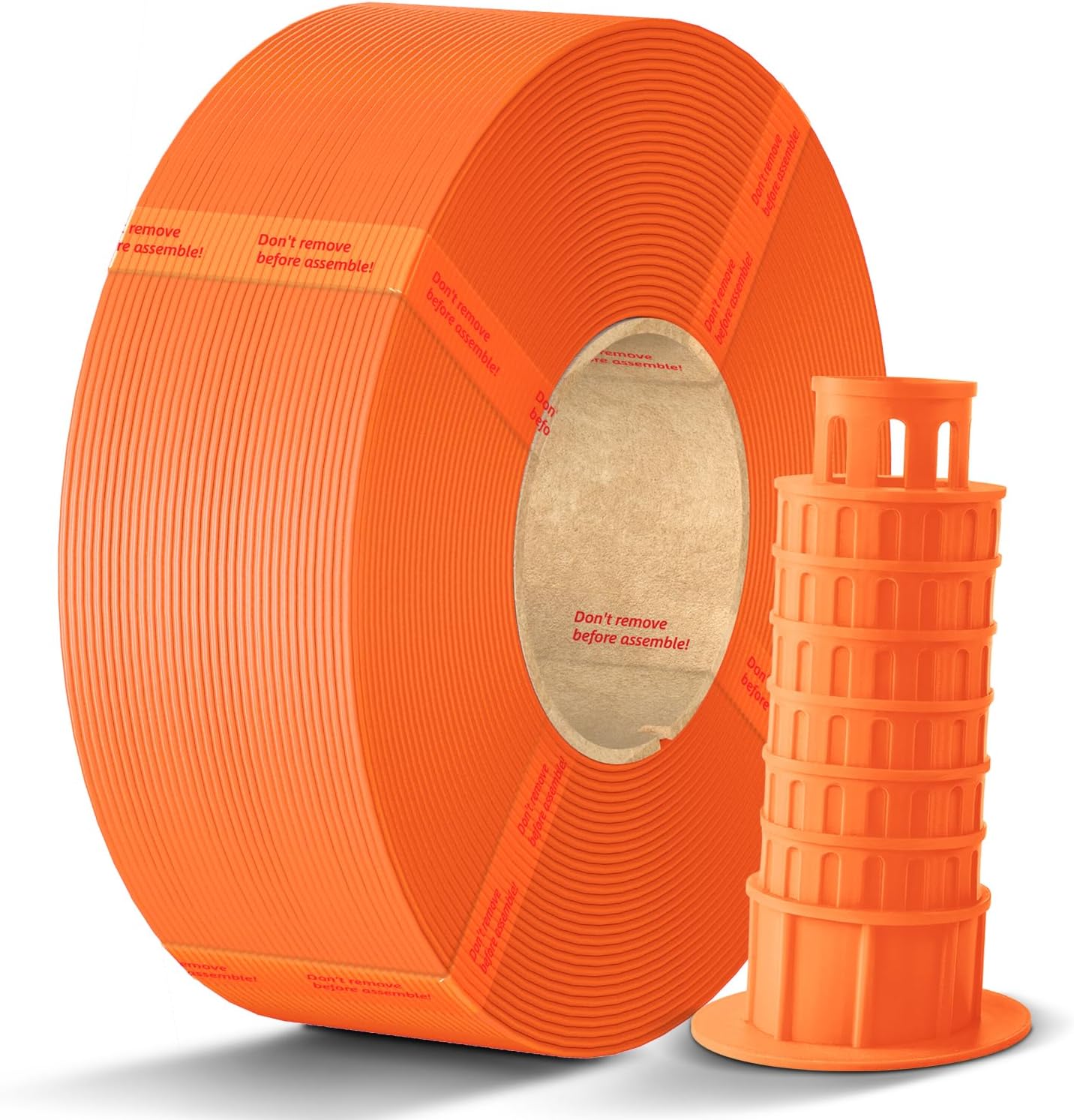
A full 1KG spool of PLA+ filament is ready to print, with 10 colors to choose from. If you already own reusable spools, the Anycubic PLA+ filament refill is the same tough PLA+ as a refill coil, in 8 colors. Both print the same way, so pick the spool if you need one and the refill if you already have one. Either way, print your next mount in PLA+ and see how it holds up after a crash.
PETG for Parts That Must Flex
PETG is the pick when a part must flex instead of breaking. Its impact resistance is twice that of standard PLA, and it bends under load instead of cracking through. That makes it right for guards, bumpers, skid plates, and chassis pieces that take direct hits. PETG also resists chemicals and water better than PLA or PLA+, which matters for a drone that flies outside in dirt and wet grass. The Anycubic PETG filament refill is a 1KG refill coil in 5 colors, and it is a refill only, with no spool included, so you need a reusable spool to use it.
PETG strings more than PLA+, so tune retraction until the strings stop, and print the first layer slow on a clean bed. Keep the filament dry, since damp PETG prints rough and weak. The extra care is worth it for parts that take hits, because a PETG guard that flexes and survives beats a PLA+ guard that cracks, even though PLA+ is the tougher material in most other ways.
HT-PLA Pro for Hot Spots
Some FPV parts sit near heat. Motor mounts, speed controller housings, and electronics enclosures can get hot enough to soften PLA and PLA+. That is where HT-PLA Pro belongs. It combines PLA Pro toughness with HT-PLA heat stability, prints up to 300mm/s, and anneals at 100C for 30 minutes for the best heat resistance. Print it at a nozzle temperature of 220 to 230C and a bed temperature of 60 to 65C, with no enclosed chamber and no hardened nozzle needed. The Polymaker HT-PLA Pro filament is a full 1KG spool in 11 colors.
-
PLA+ Filament, 1.75mm, 1KG
$24.99Select options This product has multiple variants. The options may be chosen on the product pageColor
Print orientation matters for FPV frames too. Lay a frame flat so the layers stack against the load, and a hard landing pulls across the layers instead of splitting them apart. A camera mount printed upright snaps at the base, while the same mount printed flat takes the hit. Think about the crash direction before you slice, and the part will last longer. The filament is only half the strength of a printed part, and orientation is the other half.
The short version is simple. Print mounts, brackets, and frames in PLA+. Print guards, bumpers, and parts that must flex in PETG. Print motor mounts, enclosures, and parts near heat in HT-PLA Pro. Print practice parts and prototypes in PLA. That is the whole system, and it covers every part on an FPV drone. Browse the 3D printer filament range to compare all four, and stock the ones that match the parts you print most.
Ships from our secure NY warehouse in the USA
Quality RC Parts is a USA shop, and every order ships from our secure NY warehouse. Orders leave in 1 to 2 business days with tracking sent by email, and shipping is free on orders over $100. No overseas wait, no customs. We are a working repair shop, and we stand behind every part we sell.